
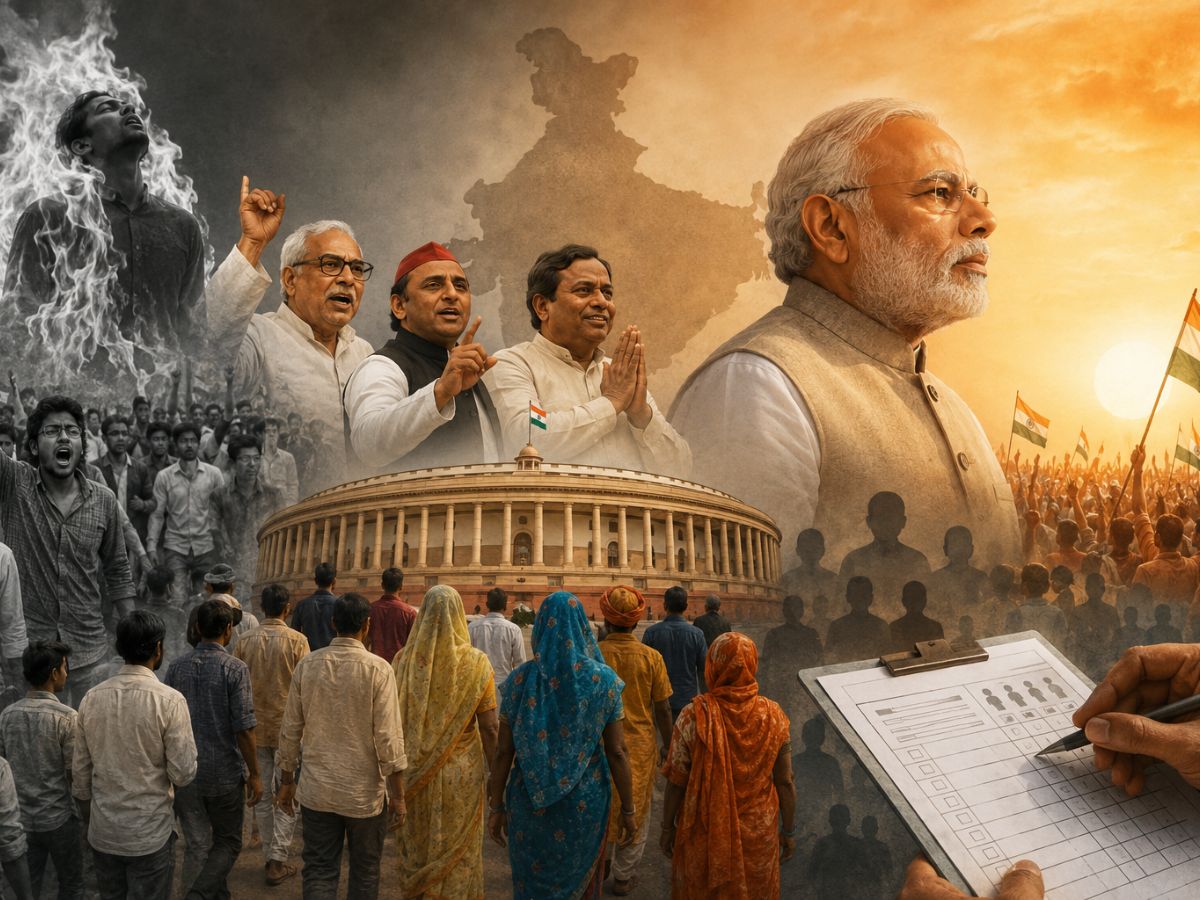
Few developments in post-Independence India have transformed the political landscape as profoundly as the implementation of the Mandal Commission recommendations in 1990. What began as a constitutional attempt to address historical inequalities among socially and educationally backward communities soon evolved into one of the defining turning points of Indian democracy. The “Mandal moment” did not merely alter reservation policy; it fundamentally reshaped the grammar of Indian politics, redistributing power from upper-caste elites to backward caste groups and redefining political representation in North India.
More than three decades later, India once again finds itself debating caste and representation through the question of a nationwide caste census. The Union government’s 2025 announcement that caste data would be included in the upcoming national census has revived unresolved debates around social justice, reservations, political representation, and national identity. At the centre of this debate lies a crucial question: has India moved beyond caste, or has caste simply been repackaged within newer narratives of nationalism, welfare, and development?
To understand contemporary India, one must revisit the long trajectory from Mandal to Modi — from caste assertion to majoritarian nationalism, from social justice politics to “development-first” politics.
Caste and the Indian State
Caste has historically shaped access to land, education, employment, and political power in India. Although the Constitution abolished untouchability and guaranteed equality before law, the makers of the Constitution recognized that formal equality alone could not erase centuries of social exclusion. As a result, provisions for affirmative action were incorporated for Scheduled Castes (SCs) and Scheduled Tribes (STs).
Dr. B. R. Ambedkar argued that political democracy would remain incomplete without social democracy. Reservations in legislatures, education, and government jobs were therefore envisioned as instruments of social transformation rather than mere welfare measures.
However, while SCs and STs received constitutional safeguards immediately after Independence, the question of Other Backward Classes (OBCs) remained unresolved for decades. The First Backward Classes Commission under Kaka Kalelkar submitted its report in 1955, but its recommendations were largely ignored due to political hesitation and concerns over caste-based mobilization.
The issue resurfaced dramatically during the Janata Party government in 1979, when Prime Minister Morarji Desai constituted the Second Backward Classes Commission under Bindeshwari Prasad Mandal, commonly known as the Mandal Commission. The commission was tasked with identifying socially and educationally backward classes and recommending measures for their advancement. Using social, educational, and economic indicators, the commission estimated that OBCs constituted roughly 52 per cent of India’s population and recommended 27 per cent reservation in Central government jobs and public sector undertakings. Combined with the existing 22.5 per cent reservation for SCs and STs, the total reservation would reach 49.5 per cent.
The Mandal Explosion of 1990
For nearly a decade, the Mandal Commission report remained politically dormant. That changed on August 7, 1990, when Prime Minister V. P. Singh announced the implementation of the commission’s recommendations.
The reaction was immediate and explosive.
Across North India, especially in urban centres and universities, anti-Mandal protests erupted. Large sections of upper-caste students viewed reservations as a threat to merit and employment opportunities. The protests soon turned violent. The most symbolic moment came when Delhi University student Rajiv Goswami attempted self-immolation in September 1990, becoming the face of anti-Mandal agitation. Several other self-immolation attempts followed, and many students lost their lives during the protests.
Yet while the protests dominated headlines, the implementation of Mandal also triggered a silent political revolution among backward castes. Communities that had long remained politically marginalised suddenly discovered the power of collective identity and democratic assertion.
The Mandal moment fractured the social dominance of upper castes in North India and gave rise to a new generation of backward caste leaders. Politicians such as Lalu Prasad Yadav and Mulayam Singh Yadav emerged as powerful champions of OBC politics, drawing ideological inspiration from socialist thinker Ram Manohar Lohia.
Simultaneously, Dalit assertion found political expression through the rise of the Bahujan Samaj Party under Kanshi Ram and later Mayawati, who became India’s first Dalit woman Chief Minister in 1995.
The Mandal era therefore represented more than reservation policy. It marked the democratization of Indian politics by expanding representation beyond traditional upper-caste elites.
Mandal versus Kamandal
The rise of backward caste politics coincided with another transformative political movement: the rise of Hindutva.
As Mandal politics mobilized caste identities, the Bharatiya Janata Party (BJP) countered it with what came to be known as “Kamandal politics” — a politics centered on Hindu religious identity. The Ram Janmabhoomi movement and the Rath Yatra led by L. K. Advani in 1990 sought to unite Hindus across caste lines through religious mobilization.
This was a crucial moment in Indian politics. Mandal emphasized caste-based social justice, while Kamandal emphasized religious unity and cultural nationalism.
For much of the 1990s, Indian politics revolved around this tension. Regional caste-based parties dominated states like Bihar and Uttar Pradesh, while the BJP gradually expanded its influence through Hindutva mobilization.
The political vocabulary of India changed permanently during this period. Terms such as “social justice,” “backward caste assertion,” “Bahujan politics,” and “identity politics” entered mainstream discourse.
The Supreme Court and the Reservation Debate
The implementation of Mandal reservations soon reached the Supreme Court in the landmark Indra Sawhney vs Union of India case of 1992, often referred to as the Mandal judgment.
A nine-judge Constitution Bench upheld the 27 per cent reservation for OBCs but introduced important limitations. The Court ruled that total reservations should ordinarily not exceed 50 per cent and introduced the concept of the “creamy layer,” excluding economically advanced members of OBC communities from reservation benefits.
The judgment became the constitutional foundation of reservation policy in India.
15% + 7.5% + 27% = 49.5%
The Court also clarified that caste could be an indicator of backwardness, though not the sole criterion. This was a critical acknowledgment of caste as a continuing social reality in India rather than merely a relic of the past.
The Rise and Decline of Mandal Politics
The Mandal era produced significant social transformation. Backward caste communities achieved unprecedented political representation. State institutions became more socially diverse. Political discourse increasingly addressed issues of dignity, representation, and social justice.
However, Mandal politics also faced internal contradictions.
Many backward caste parties gradually became dominated by particular caste groups such as Yadavs in Uttar Pradesh and Bihar. Critics argued that these parties failed to adequately represent the most marginalized communities, including Dalits and Extremely Backward Classes (EBCs). Corruption, dynastic politics, and administrative failures further weakened their credibility over time.
By the early 2000s, a growing section of voters — especially younger and urban voters — appeared fatigued with caste-centric politics. Aspirations around economic growth, infrastructure, and development gained increasing political importance.
It was within this context that the BJP under Narendra Modi emerged as a dominant national force.
From Mandal to Modi
Narendra Modi’s rise marked a major shift in the language of Indian politics.
Interestingly, Modi himself belongs to an OBC community, and the BJP strategically expanded its support among non-dominant OBC groups. However, unlike traditional Mandal parties, the BJP did not foreground caste-based justice as its primary political language.
Instead, Modi projected a narrative centered on nationalism, development, welfare delivery, and aspirational politics. The slogan “Sabka Saath, Sabka Vikas” suggested a politics that transcended caste divisions.
This did not mean caste disappeared from politics. Rather, caste was reconfigured.
The BJP’s political strategy involved combining Hindu majoritarianism with targeted outreach to non-dominant OBCs and Dalits. Welfare schemes such as free cooking gas connections, housing assistance, and direct benefit transfers were framed in universal terms rather than explicitly caste-based terms.
As a result, the old Mandal coalition fragmented. Traditional caste-based parties struggled to maintain their social bases as many OBC voters shifted toward the BJP.
This transformation led many scholars to describe contemporary Indian politics as moving toward “de-Mandalisation” — a weakening of explicit caste-centered politics in favour of broader religious and nationalist identities.
The Caste Census Debate
Despite claims that India is moving beyond caste, demands for updated caste data have intensified in recent years.
The last comprehensive caste census was conducted in 1931 during British rule. While SCs and STs continue to be counted after Independence, no official nationwide data exists for OBC populations.
In 2023, the Bihar government released findings from its caste survey showing that OBCs and EBCs together constituted more than 63 per cent of the state’s population. The survey reignited demands for a nationwide caste census and strengthened calls for proportional representation in jobs, education, and political institutions.
Supporters argue that accurate caste data is essential for evidence-based policymaking. Without updated data, reservation policies continue to rely on outdated estimates nearly a century old.
The demand has found strong support in states like Tamil Nadu, where Dravidian politics historically emphasized caste-based social justice. Political parties such as the Dravida Munnetra Kazhagam have welcomed caste enumeration as necessary for ensuring equitable representation.
In contrast, reactions in many northern states have been more cautious. Critics argue that caste enumeration could deepen social divisions and revive identity politics.
Yet the resistance to caste census raises a deeper question: why is the Indian state reluctant to count caste if caste inequalities continue to exist?
Sociologist Satish Deshpande famously described this phenomenon as “castelessness as privilege” — the ability of dominant groups to appear neutral and meritocratic while continuing to benefit from historical advantages.
North versus South: Divergent Political Cultures
The debate around caste census also highlights the sharp regional differences in India’s political culture.
Southern states, especially Tamil Nadu, have a long history of anti-caste movements and social justice politics. The Self-Respect Movement led by Periyar E. V. Ramasamy challenged Brahminical dominance decades before Mandal politics emerged nationally.
As a result, caste-based reservations and welfare policies became deeply institutionalized in the South.
In much of North India, however, caste assertion emerged later through Mandal politics and was subsequently overshadowed by Hindutva politics. Welfare populism and religious nationalism increasingly replaced explicit caste mobilization.
This divergence explains why southern states generally support caste enumeration while northern politics remains more ambivalent.
Identity Politics and Indian Democracy
The broader debate around caste census ultimately reflects the larger question of identity politics in India.
Identity politics has played a contradictory role in Indian democracy. On one hand, it has empowered historically marginalized communities by giving them political voice and representation. Dalit movements, backward caste mobilization, feminist politics, and regional movements have deepened democratic participation.
On the other hand, identity politics has also produced polarization, sectarianism, and competitive victimhood. Political parties often reduce communities into vote banks, prioritizing symbolic representation over substantive transformation.
Sociologists such as Louis Dumont and Max Weber help explain why caste continues to remain politically powerful. Dumont viewed caste as a deeply hierarchical social order, while Weber’s concept of “status groups” explains how communities mobilize for recognition and political power.
Even today, caste shapes access to education, jobs, social capital, and institutional representation. Urbanization and economic growth have weakened some traditional hierarchies, but caste remains embedded in marriage patterns, electoral politics, and social networks.
The journey from Mandal to Modi reflects the evolving nature of Indian democracy itself.
The Mandal era democratized power by bringing backward castes into the political mainstream. It challenged upper-caste dominance and transformed caste into a language of rights and representation. The Modi era, by contrast, has sought to subsume caste within broader narratives of nationalism, development, and Hindu unity.
Yet caste has not disappeared. It remains central to social and political life, even when political discourse attempts to move beyond it.
The contemporary debate around caste census is therefore not merely about statistics. It is about visibility, accountability, and representation. To count caste is to acknowledge inequality. To refuse to count it is to risk denying the persistence of structural injustice.
India’s democratic future may ultimately depend on whether it can reconcile two competing aspirations: the aspiration for a casteless society and the need for caste-based justice in a deeply unequal social order.
The Mandal moment asked India to confront caste directly. The Modi era asks whether India can move beyond caste without first resolving the inequalities caste created.