
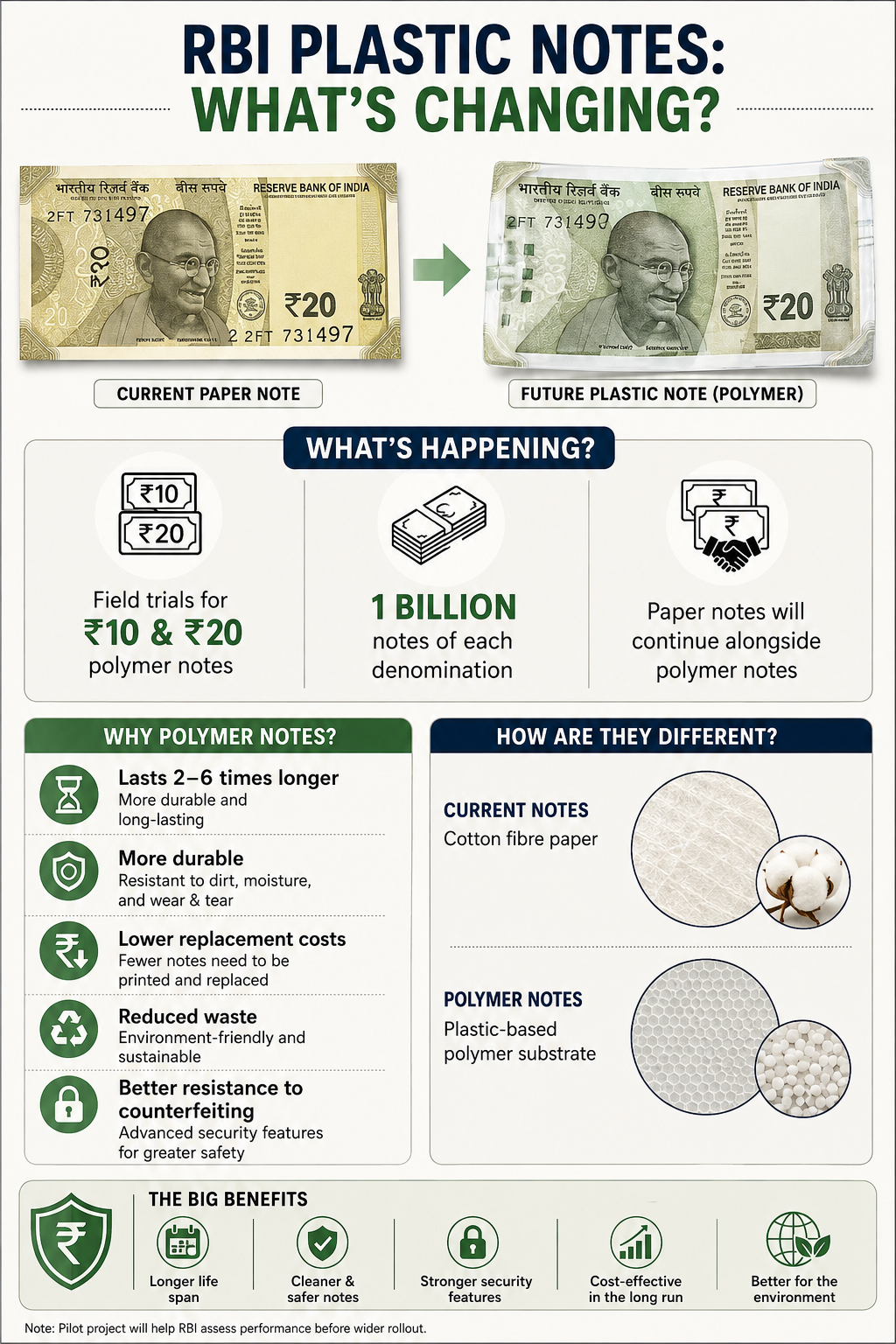
RBI’s plastic banknote plan is the latest milestone in a monetary journey spanning over 2,500 years
The story of India’s currency is, in many ways, the story of India itself. Every coin minted, every note printed and every security feature introduced has reflected the country’s political transitions, economic ambitions and technological progress. This week, the Reserve Bank of India (RBI) added another chapter to that story by announcing plans to introduce polymer (plastic) banknotes in select denominations. The pilot project aims to test banknotes that are stronger, cleaner, longer-lasting and more secure than the cotton-paper notes Indians have used for decades.
The announcement comes at an interesting moment. India is one of the world’s fastest-growing digital payment economies. UPI has transformed the way people shop, pay bills and transfer money, while the Digital Rupee is gradually being introduced through pilot programmes. Yet cash remains indispensable. From vegetable markets and village shops to temples and public transport, the rupee note continues to be the country’s most trusted instrument of exchange.
The RBI’s decision is therefore not about replacing cash—it is about reinventing it. Like every major currency reform before it, the shift to polymer notes reflects changing needs, new technology and evolving threats. Looking back through history shows that Indian money has never remained static. It has constantly adapted to the demands of each era.
The First Money of India
Long before paper currency existed, trade in ancient India relied on barter. Farmers exchanged grain for livestock, artisans traded tools for food, and merchants negotiated value through commodities. As trade networks expanded, barter became increasingly inefficient.
Around the sixth century BCE, during the Mahajanapada period, India witnessed the emergence of some of the world’s earliest coins. Known as punch-marked coins, these silver pieces bore symbols stamped by rulers rather than portraits or inscriptions. They simplified trade and laid the foundation for a standard monetary system.
Under the Mauryan Empire, particularly during the reign of Chandragupta Maurya and Ashoka, coinage became more organised. The Gupta Empire later introduced beautifully crafted gold coins that celebrated royal achievements, religion and art. These coins are still regarded among the finest examples of ancient Indian metallurgy and craftsmanship.
The Birth of the Rupee
The modern rupee owes much to Sher Shah Suri, the Afghan ruler who briefly interrupted Mughal rule in the sixteenth century. He introduced the silver Rupiya, a standardised coin weighing around 11.5 grams.
Its consistency revolutionised trade. Merchants travelling across northern India no longer needed to calculate the varying values of local coins. The Mughal emperors who succeeded Sher Shah retained and expanded this system, helping establish the rupee as the dominant currency of the subcontinent.
Even after centuries, the name “rupee” survives, making it one of the world’s oldest continuously used currency names.
Colonial Currency and the Rise of Paper Notes
British rule transformed India’s monetary landscape once again.
Initially, different presidencies—Bengal, Bombay and Madras—issued their own currencies. This created confusion for traders operating across regions. The need for a uniform system led to the Paper Currency Act of 1861, which granted the colonial government exclusive authority to issue banknotes.
Paper currency changed commerce dramatically. Unlike heavy metal coins, banknotes were easier to transport, count and store. Early notes displayed portraits of British monarchs, including Queen Victoria and later Kings Edward VII, George V and George VI.
Even then, authorities faced a challenge that remains relevant today—counterfeit currency. Watermarks, intricate patterns and specialised printing techniques became essential security features.
Independence Brings a New Identity
When India became independent in 1947, it inherited the colonial currency system but needed a national identity.
In 1949, independent India’s first banknotes replaced the British monarch with the Lion Capital of Ashoka at Sarnath. This seemingly simple design change carried enormous symbolic importance. Currency now represented a sovereign democratic republic rather than an empire.
The Reserve Bank of India, established in 1935, became the country’s sole currency issuer and gradually modernised the design and production of banknotes.
Decimalisation: Making the Rupee Simpler
One of the most practical reforms came in 1957.
For generations, Indians calculated money using annas, paise and pies. One rupee equalled sixteen annas, making arithmetic unnecessarily complicated.
Decimalisation simplified everything.
One rupee became equal to one hundred paise, making banking, accounting and commerce more efficient. Though many older Indians continued using the term “anna” for years, the decimal system eventually became universal.
It remains one of the most successful monetary reforms in independent India.
Mahatma Gandhi Becomes the Face of the Rupee
In 1996, India introduced the Mahatma Gandhi Series, replacing the Ashoka Pillar as the primary image on banknotes.
The change created a common visual identity across all denominations while introducing stronger security features. Watermarks, latent images, security threads, optically variable ink and micro-lettering made counterfeit production increasingly difficult.
The reverse side of the notes celebrated India’s diversity, depicting subjects ranging from agriculture and wildlife to scientific achievements and cultural heritage.
For nearly three decades, Mahatma Gandhi has remained the face of Indian currency.
Demonetisation and a New Generation of Notes
Perhaps no monetary reform generated as much debate as the demonetisation of November 2016.
The withdrawal of ₹500 and ₹1,000 notes from circulation was followed by the launch of an entirely redesigned family of banknotes. The colourful Mahatma Gandhi New Series introduced improved security features, reduced note sizes and distinct colours for each denomination.
The ₹500 note featured the Red Fort, the ₹100 showcased Rani ki Vav, while the ₹10 displayed the Sun Temple at Konark. The ₹2,000 note highlighted India’s Mars Orbiter Mission, celebrating the country’s achievements in space exploration.
The redesign also improved accessibility for visually impaired users through tactile identification marks.
Why Is RBI Moving Towards Polymer Notes?
The latest announcement by the RBI addresses a simple reality—paper currency has limitations.
India’s notes are made from cotton-based paper, which performs well but wears out quickly in a tropical climate. High humidity, dust, repeated folding and heavy circulation reduce their lifespan significantly.
Every year, millions of damaged notes must be withdrawn and replaced, increasing printing costs.
Polymer notes provide an alternative.
Manufactured using a specialised plastic substrate, they remain cleaner, resist tearing and last two to four times longer than paper notes. They are waterproof, difficult to stain and less susceptible to everyday wear.
For a country with one of the world’s largest cash circulation networks, these advantages are substantial.
Stronger Defence Against Counterfeiting
Security remains another major reason for the transition.
Counterfeit currency has challenged governments for decades. As printing technology becomes more sophisticated, central banks must continuously upgrade security features.
Polymer banknotes allow transparent windows, holograms, metallic strips, colour-shifting images and intricate transparent elements that are extremely difficult to duplicate.
These innovations strengthen public confidence in physical currency while helping law-enforcement agencies combat fake notes.
Learning from the World
India is far from the first country to experiment with polymer currency.
Australia introduced the world’s first polymer banknotes in 1988 after years of research. The innovation proved remarkably successful.
Since then, countries including Canada, New Zealand, Singapore, the United Kingdom, Mexico, Vietnam, Romania and Nigeria have adopted polymer notes either completely or for selected denominations.
Their experience shows that although polymer notes cost more to manufacture initially, their longer lifespan significantly reduces replacement costs.
Many central banks also report lower environmental impact because fewer notes need to be printed over time.
Cash in the Age of UPI
Some may wonder why India is investing in better cash when digital payments are booming.
The answer lies in India’s diversity.
Urban consumers increasingly rely on QR codes and smartphones, but millions of Indians still depend on physical cash. Small vendors, agricultural markets, religious donations and remote regions continue to function primarily through banknotes.
Cash also provides resilience during internet outages, power failures and technical disruptions.
Rather than competing with digital payments, polymer notes complement India’s broader payment ecosystem.
Challenges Ahead
Introducing polymer notes will not happen overnight.
Printing facilities require new technology, banks must adapt cash-handling equipment, and ATM machines may need calibration. Public education campaigns will also be necessary to familiarise people with the new look and feel of polymer currency.
The transition is therefore expected to be gradual, beginning with limited pilot circulation before wider adoption.
A New Chapter in an Ancient Story
India’s currency has survived empires, colonial rule, independence, economic reforms and the digital revolution. Each transformation has reflected the changing aspirations of the nation.
The RBI’s proposal to introduce polymer banknotes is not merely about replacing paper with plastic. It represents another step in India’s long tradition of modernising its monetary system while preserving public trust in the rupee.
Thousands of years ago, merchants trusted the weight of a silver coin. Today, citizens trust the security features embedded within a banknote—or the digital confirmation on a smartphone screen. The medium has changed, but confidence remains the foundation of every currency.
If the pilot succeeds, the polymer note could become another historic milestone alongside the introduction of the rupee by Sher Shah Suri, the first paper currency under British rule, the decimalisation of 1957, the Mahatma Gandhi Series of 1996 and the redesigned notes after 2016.
From punch-marked silver coins to high-security polymer banknotes, the evolution of India’s currency mirrors the evolution of the nation itself—constantly adapting, embracing innovation and preparing for the future while carrying the weight of its remarkable past.

