
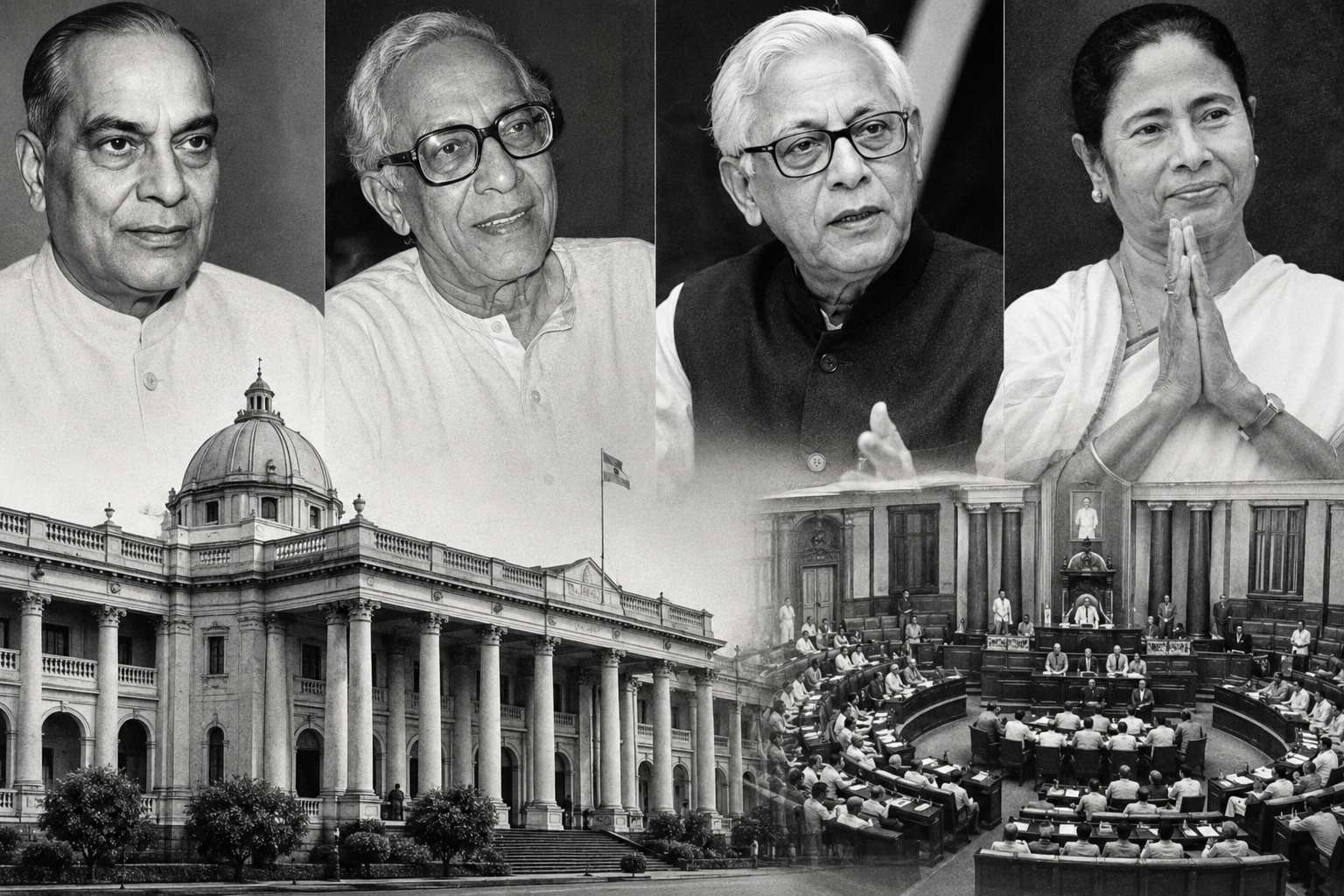
By tracing the state’s finances across seven decades, one can read the evolution of West Bengal’s politics itself—from post-Independence industrial optimism and Left-wing agrarian reforms to welfare-driven governance and the emergence of a new ideological contest.
Introduction: Budgets as Political Documents
A budget is much more than a statement of revenues and expenditures. It reflects the priorities, ideology and political compulsions of a government. In West Bengal, where politics has often shaped national discourse, budgetary decisions have mirrored larger historical changes. Every ruling dispensation—from the Congress under Dr. Bidhan Chandra Roy to the Left Front, the Trinamool Congress and the rise of the Bharatiya Janata Party (BJP) as the principal opposition—has used the budget to define its vision of development.
Over nearly eight decades, West Bengal’s budgets have chronicled changing concerns: industrialization, refugee rehabilitation, agrarian reform, decentralization, welfare schemes, fiscal deficits and competitive populism. Examining these budgets provides an alternative history of modern Bengal.
The Bidhan Chandra Roy Era (1948–1962): Building a New State
When Dr. Bidhan Chandra Roy assumed office in 1948, West Bengal was dealing with the consequences of Partition. Millions of refugees had entered the state from East Pakistan, creating enormous social and economic pressures.
The early Congress governments inherited a province that had lost much of its agricultural hinterland but retained industrial assets concentrated around Kolkata. Budgets during this period reflected the Nehruvian vision of planned economic development.
Key Priorities
1. Refugee Rehabilitation
Large portions of expenditure went toward housing, education and rehabilitation of displaced populations. Refugee colonies emerged across Kolkata and adjoining districts.
2. Industrial Expansion
Dr. Roy believed that industrial growth would secure Bengal’s future. His governments promoted:
· Durgapur Steel Plant
· Chittaranjan Locomotive Works
· Durgapur township
· Kalyani township
· Expansion of engineering and heavy industries
Budgetary allocations focused heavily on infrastructure, electricity and industrial estates.
3. Health and Education
A renowned physician himself, Bidhan Roy expanded healthcare facilities and medical colleges. Investment in education increased significantly.
Political Significance
Budgets under Bidhan Roy reflected the Congress ideology of nation-building and state-led industrialization. Public investment was seen as a vehicle for modernization.
The Crisis Years (1962–1977): Economic Stagnation and Political Instability
After Bidhan Roy’s death in 1962, West Bengal entered a prolonged phase of instability. Successive Congress governments struggled with:
· Food shortages
· Inflation
· Labour unrest
· Refugee pressures
· Political fragmentation
· The Naxalite movement
Between 1967 and 1972, coalition governments frequently collapsed. Political violence and uncertainty affected economic growth.
Budget Priorities
Increasing expenditure went toward:
· Food procurement
· Law and order
· Administrative functions
· Subsidies
Developmental spending suffered.
Industrial Decline
The state witnessed:
· Frequent strikes
· Closure of factories
· Flight of capital
· Growing unemployment
The traditional industrial base, once among the strongest in India, began losing competitiveness.
Siddhartha Shankar Ray and Emergency-Era Governance
Chief Minister Siddhartha Shankar Ray (1972–77) attempted administrative reforms and stronger law-and-order measures. Budgetary focus shifted toward governance and security amid rising Naxalite violence.
By the mid-1970s, Bengal’s economy had entered a period of stagnation, creating fertile ground for political change.
The Left Front Revolution (1977–2000): Budgets for the Countryside
The victory of the Left Front under Jyoti Basu in 1977 marked one of India’s most durable political transformations. The Left Front remained in power for 34 years—the longest democratically elected communist government in the world.
Its budgets represented a sharp departure from Congress-era priorities.
Land Reforms and Operation Barga
The Left government’s most celebrated programme was Operation Barga, which provided security to sharecroppers.
Budget allocations increasingly favored:
· Rural development
· Agricultural credit
· Irrigation projects
· Panchayati Raj institutions
· Cooperatives
Decentralized Governance
West Bengal pioneered decentralization through elected panchayats.
Funds flowed through local bodies, making village institutions central to development.
Agricultural Success
During the 1980s, West Bengal recorded impressive agricultural growth.
Production of:
· Rice
· Vegetables
· Fisheries
rose considerably.
The state’s budgets consistently prioritized:
· Minor irrigation
· Rural roads
· Agricultural support
The Political Message
The Left projected itself as the defender of peasants and workers.
Budgets became instruments of redistribution rather than industrial expansion.
The Cost of Industrial Neglect
Although agriculture prospered, critics argued that the Left’s labour policies discouraged private investment.
By the 1990s:
· Manufacturing growth slowed.
· Industrial disputes increased.
· Major businesses shifted elsewhere.
· Employment opportunities declined.
Meanwhile, the state government faced mounting fiscal pressures.
Salaries and Pensions
Government expenditure increasingly went toward:
· Employee salaries
· Pension liabilities
· Interest payments
Development expenditure shrank.
West Bengal became one of India’s most indebted states.
Liberalization and Jyoti Basu’s Pragmatism
India’s economic liberalization in 1991 forced state governments to rethink development strategies.
Jyoti Basu gradually adopted a pragmatic approach.
Budget speeches began mentioning:
· Information technology
· Private investment
· Infrastructure
· Foreign collaboration
Yet ideological limitations and bureaucratic hurdles slowed reforms.
Debt burdens continued to rise.
Buddhadeb Bhattacharjee and the Return of Industry (2000–2011)
Buddhadeb Bhattacharjee sought to modernize Bengal’s economy.
His slogan, “Do It Now,” symbolized a shift from ideological rigidity toward industrial revival.
New Budget Priorities
Greater emphasis was placed on:
· IT parks
· Urban infrastructure
· Roads
· Industrial investment
· SEZs
· Manufacturing
Kolkata’s Sector V emerged as a major IT hub.
Tata Nano Project
The proposed Tata Motors plant at Singur became the symbol of this industrial push.
The government argued that industrialization was essential for employment generation.
However, opposition over land acquisition transformed the political narrative.
Singur and Nandigram: Budgets Meet Politics
The Singur and Nandigram movements changed Bengal’s political landscape.
Led by Mamata Banerjee, protests highlighted concerns about:
· Farmers’ rights
· Forced acquisition
· Compensation
· Livelihood security
The controversies undermined the Left’s image.
Ironically, after decades of defending peasants, the Left was accused of sacrificing agricultural interests for industry.
Budgetary promises of industrial growth became politically costly.
The 2011 Assembly elections ended 34 years of Left rule.
Mamata Banerjee’s First Challenge: Managing Debt (2011–2016)
When Mamata Banerjee assumed office, she inherited debt exceeding ₹2 lakh crore.
Her governments repeatedly argued that debt servicing consumed a large part of state revenues.
Budget Philosophy
The Trinamool Congress emphasized:
“Ma, Mati, Manush” (Mother, Motherland, People).
Budgets shifted toward social welfare and direct assistance.
Flagship Schemes
Kanyashree
Financial incentives to encourage girls’ education and prevent child marriage.
The scheme later received international recognition from the United Nations.
Sabuj Sathi
Bicycles for school students.
Khadya Sathi
Subsidized food grains.
Rupashree
Financial support for marriage of women from economically weaker families.
Political Impact
These schemes expanded the government’s reach among rural and lower-income populations.
Budgets became tools for welfare-driven governance.
Welfare Politics and Women’s Empowerment (2016–Present)
West Bengal’s budgets increasingly focused on women.
Lakshmir Bhandar
Perhaps the state’s most influential welfare scheme, Lakshmir Bhandar provides direct monthly assistance to women.
Budget allocations for the programme have steadily increased.
Other Programmes
· Swasthya Sathi health insurance
· Student Credit Card Scheme
· Krishak Bandhu
· Duare Sarkar outreach programme
These initiatives transformed the state’s welfare architecture.
The Political Dimension
The Trinamool Congress built strong support among women beneficiaries.
Budget announcements increasingly became political instruments aimed at consolidating social coalitions.
Infrastructure Development Under TMC
Critics often portray the TMC government as excessively welfare-oriented, but budgets have also emphasized infrastructure.
Investment has been directed toward:
· Roads
· Bridges
· Drinking water projects
· Health facilities
· Urban development
Administrative decentralization led to creation of new districts and subdivisions.
The state has also invested heavily in:
· Tourism
· MSMEs
· Rural connectivity
Yet industrial investment has not matched expectations.
Debt Remains the Biggest Challenge
Regardless of the ruling party, West Bengal has consistently grappled with debt.
Interest payments account for a significant share of expenditure.
Major challenges include:
Revenue Constraints
The state’s own tax revenue remains limited.
Salary Burden
Government employees and pensions consume substantial resources.
Limited Capital Investment
Welfare commitments leave less room for major industrial projects.
Dependence on Central Transfers
The state frequently accuses the Centre of withholding dues under various schemes.
Financial federalism has emerged as a recurring issue in budget speeches.
The Rise of BJP and a New Fiscal Narrative
Since 2019, the Bharatiya Janata Party has emerged as the principal opposition force in West Bengal.
Though not governing the state, BJP has significantly influenced budget debates.
BJP’s Criticisms
The party argues that:
· Debt levels are unsustainable.
· Industry needs revival.
· Employment generation is inadequate.
· Welfare spending has become excessive.
· Corruption affects delivery mechanisms.
Competitive Welfare Politics
At the same time, BJP promotes central schemes such as:
· PM-Kisan
· Ayushman Bharat
· PM Awas Yojana
This has created parallel welfare narratives between Kolkata and New Delhi.
State budgets increasingly highlight schemes distinct from those of the Centre, turning finances into instruments of political competition.
Changing Ideologies Through Budgets
Congress Era
Theme: Industrial modernization
Focus: Infrastructure, heavy industry and institution building.
Left Front Era
Theme: Agrarian socialism
Focus: Land reforms, agriculture and decentralization.
Buddhadeb Phase
Theme: Industrial revival
Focus: Investment and modernization.
Trinamool Congress Era
Theme: Welfare and social inclusion
Focus: Women, farmers and direct benefits.
BJP Narrative
Theme: Growth-oriented governance
Focus: Investment, jobs and central welfare schemes.
The history of West Bengal’s budgets is, in many ways, the history of West Bengal itself.
Bidhan Chandra Roy’s budgets reflected post-Independence optimism and industrial ambition. The Left Front transformed finances into instruments of agrarian empowerment and decentralization. Buddhadeb Bhattacharjee attempted to revive industry but was overtaken by political resistance. Mamata Banerjee ushered in an era of welfare-centric governance, placing women and social protection at the centre of fiscal policy. Meanwhile, the rise of the BJP has created a new contest over development models and welfare politics.
Throughout these transitions, one challenge has remained remarkably constant—balancing growth with social justice while managing a persistent debt burden.
Thus, West Bengal’s budgets are not merely accounting exercises. They are political manifestos, reflections of ideological battles and records of changing aspirations. From Bidhan Roy to the BJP era, the numbers in budget documents reveal how successive governments sought to shape society, win public trust and define the future of Bengal.
In that sense, the state’s political history is written not only in election victories and party symbols, but also in tax proposals, welfare allocations and expenditure priorities. The budget, year after year, has served as the most revealing mirror of West Bengal’s changing political soul.