
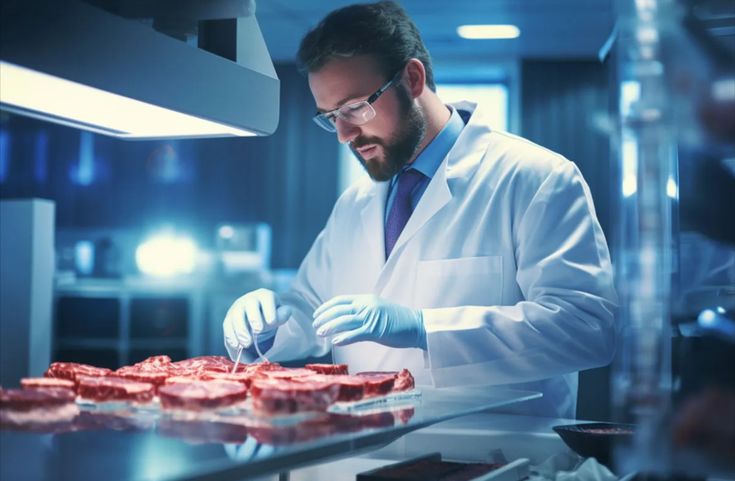
NEW DELHI: Lab-grown meat has long been framed as a futuristic solution to global food challenges. Now, it has entered mainstream pop culture. In a recent video, Jimmy Donaldson, better known as MrBeast, stepped inside a $200 million lab operated by food technology company Upside Foods, offering millions of viewers a rare look at how chicken meat can be grown without raising or slaughtering animals.
The visit, featured in his video “$1 vs $1,000,000,000 Futuristic Tech!”, has already crossed 58 million views, igniting widespread debate across social media platforms. While some hailed the technology as revolutionary, others questioned its cost, naturalness, and scalability.
INSIDE A $200 MILLION MEAT LAB
In the video, MrBeast tours Upside Foods’ high-tech facility, where cultivated—or cell-grown—meat is produced. Instead of raising chickens on farms, the company grows real chicken meat directly from animal cells in carefully controlled laboratory conditions.
The process begins with cells taken from a fertilized heritage-breed chicken egg. These cells are placed into large steel tanks called cultivators, where they are fed a nutrient-rich mixture that allows them to grow and multiply into muscle tissue—the same tissue people eat as meat.
Unlike traditional farming, cultivated meat focuses solely on producing edible portions, eliminating the need to raise, feed, and slaughter entire animals. Upside Foods says its approach aims to reduce environmental impact, lower land and water use, and significantly cut animal suffering, while still delivering meat that is biologically identical to conventional chicken.
HOW LAB-GROWN CHICKEN IS MADE
Cultivated meat production is designed to replicate natural muscle growth—without the animal. The process typically involves four key steps:
CELL SELECTION: Scientists collect a small sample of animal cells. Upside Foods’ first cultivated chicken product was developed using cells from a fertilized chicken egg.
CELL SELECTION AND BANKING: The most efficient and stable cells are selected and stored in a cell bank, allowing consistent production over time.
CULTIVATION AND GROWTH: The cells are placed in cultivators filled with nutrients such as water, sugars, amino acids, vitamins, minerals, and salts. As the cells multiply, they are moved into larger tanks to continue growing under tightly monitored conditions.
HARVESTING AND SHAPING: After two to three weeks, the meat is harvested and separated from the nutrient solution. It is then shaped into products such as chicken fillets, and may be seasoned or processed further before cooking.
IS LAB-GROWN MEAT SAFE?
In June 2023, the US Department of Agriculture approved Upside Foods and Good Meat—both based in California—to sell cultivated meat for human consumption. The decision followed years of safety reviews, making the US one of the first countries to formally allow lab-grown meat to enter restaurants and, eventually, retail markets.
Following MrBeast’s visit, Upside Foods founder and CEO Uma Valeti shared a LinkedIn post describing the episode as a milestone moment. He said the video highlighted innovations that could help lay “the foundation for the future of humanity.”
Upside Foods says its approach aims to reduce environmental impact, lower land and water use, and significantly cut animal suffering, while still delivering meat that is biologically identical to conventional chicken.
VIRAL REACTIONS: EXCITEMENT MEETS SCEPTICISM
The video also gained traction on X, where reactions were sharply divided. Supporters praised the exposure. “The future of food just hit the biggest table on the internet,” one user wrote. Another commented, “Lab-grown meat is real meat—no slaughter, less land, less water. If this scales, it could save billions of animals.”
Critics, however, raised concerns about cost, authenticity, and consumer acceptance. One user compared cultivated meat to lab-grown diamonds, noting that despite being identical, many people still prefer “natural” versions. Others questioned affordability, pointing out that a conventional chicken sandwich costs far less than its lab-grown counterpart.
“I need my chicken to be chicken,” one user wrote bluntly.
The video may not resolve the debate around cultivated meat, but it has undeniably pushed the conversation into the mainstream. As the technology develops, questions around price, scalability, regulation, and public trust will shape whether lab-grown meat becomes a niche novelty—or a staple on future dinner plates.