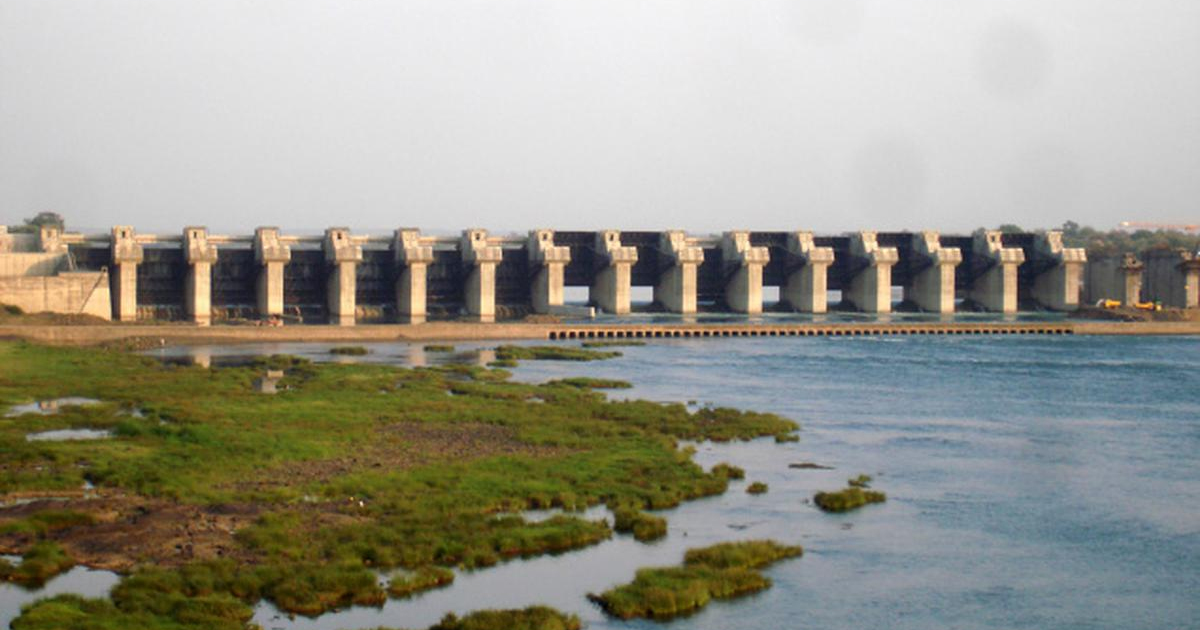
The Maheshwar Dam, located on the Narmada River in Madhya Pradesh, is India’s first hydropower project promoted under a public-private partnership (PPP). Today, following almost three decades of suspended progress, financial anomalies, and unfinished rehabilitation of affected villages, the project stands to become the first dam in India to be auctioned after an order from the National Company Law Tribunal (NCLT) on 11 July 2025.
The NCLT passed its judgment in a case instituted by Power Finance Corporation (PFC) against Shree Maheshwar Hydel Power Corporation Limited (SMHEC), the private company handling the dam project. PFC had claimed SMHEC defaulted on its loans and also failed to develop the dam. The tribunal granted several extensions to the company beyond the legally permitted 180-day extension period under the Corporate Insolvency Resolution Process (CIRP), which amounted to 840 days in the end.
When SMHEC requested a second extension, the NCLT denied the request and allowed the commencement of the auction process. As per Advocate Amol Srivastava, “In such cases, the tribunal declares the company bankrupt and appoints an official liquidator. It is he who takes forward the process of auctioning the company.”
A Controversial Public-Private Venture
The Narmada Valley Development Authority (NVDA) originally suggested the Maheshwar project in 1978. The Madhya Pradesh State Electricity Board took over in 1989, but the state government transferred the project to S Kumars, a textile group, by 1993. In 1996, a Memorandum of Understanding (MoU) was executed, transferring control of construction, commissioning, and maintenance of the project to S Kumars. The company held a 33% stake in SMHEC, with the remaining shares owned by multinational companies.
Officials asserted that the inclusion of the private sector would quicken the construction process and minimize the financial load on the state. Nevertheless, after 31 years, the project is only 70% finished and has not produced a single unit of electricity.
High Costs and Mass Displacement
The project, in Mandleshwar, Khargone, has already displaced around 60,000 people from 61 villages. Vows of equitable compensation and land rehabilitation — 5 to 20 acres for families who are losing more than 25% of their land — are yet to be honored.
As per Alok Agrawal of Narmada Bachao Andolan, who has been resisting the dam since its planning:
“The cost of the electricity produced out of this dam was estimated to be very high, and lots of people were going to lose their homes as a result of this.”
The capacity at which the dam was to be installed was 400 megawatts, but the estimated unit cost of electricity was ₹9, three times that in other Narmada dams such as Indira Sagar and Omkareshwar, where the unit cost is ₹3.
Administrative Failures and Late Communication
Villagers knew nothing about the dam initially. Only when activists from Narmada Bachao Andolan acted did the displaced residents come to know about the project. This failure to keep information transparent resulted in mass protests. On 11 January 2000, more than 1,500 individuals, including author Arundhati Roy, were arrested for conducting peaceful demonstrations at the dam site.
In response to environmental and human rights concerns, the Union Ministry of Environment and Forests issued a show cause notice to SMHEC on 17 February 2010 and a stop-work order on 23 April 2010 under the Environment (Protection) Act 1986.
Nevertheless, the then Chief Minister Shivraj Singh Chouhan was against this action and had written to the Prime Minister’s Office. A compromise permitted work on 7 already-installed gates to be continued, but disallowed work on the remaining 5.
Contrary to a 2011 state government report, which stated that 70% of the rehabilitation work was done, the Centre had not agreed. Activists point out that 85% of the displaced people are still unrehabilitated even today.
Skyrocketing Costs and Abandoned Agreements
SMHEC had taken approximately ₹1,900 crore of loans from organizations such as PFC, but utilized only ₹499 crore from its resources. The project cost was escalated due to delays from ₹1,569 crore (original estimate) to ₹4,635 crore by 2015.
On 18 April 2020, the Madhya Pradesh Power Management Company Limited (MPPMCL) canceled its agreement for purchasing power with SMHEC. In its letter, the state organization mentioned:
The per unit tariff of electricity produced out of this project would be ₹18, which is aberrant and extremely high, far exceeding the initial estimates or the contracted cappings.”
Subsequently, on 27 September 2022, Chief Minister Shivraj Singh Chouhan formally revoked all the agreements with SMHEC.
What Happens Next?
The dam wall is currently complete, and 3 of the 10 turbines are installed. The company now has this infrastructure as well as the land purchased from villagers, which will be auctioned to claim dues.
After the NCLT order, villagers have petitioned a memorandum to the office of Mandleshwar SDM, seeking immediate compensation and the restarting of the project. They emphasize that rehabilitation of all other families should take place before any further action.
Ground Report attempted to contact MPPMCL officials for a statement, but has yet to hear back.
The questions now are clear: Will the Maheshwar Dam be decommissioned? Will it ever be finished under new management? And above all, what’s the future for the displaced families, who have been stuck in this decades-long purgatory?