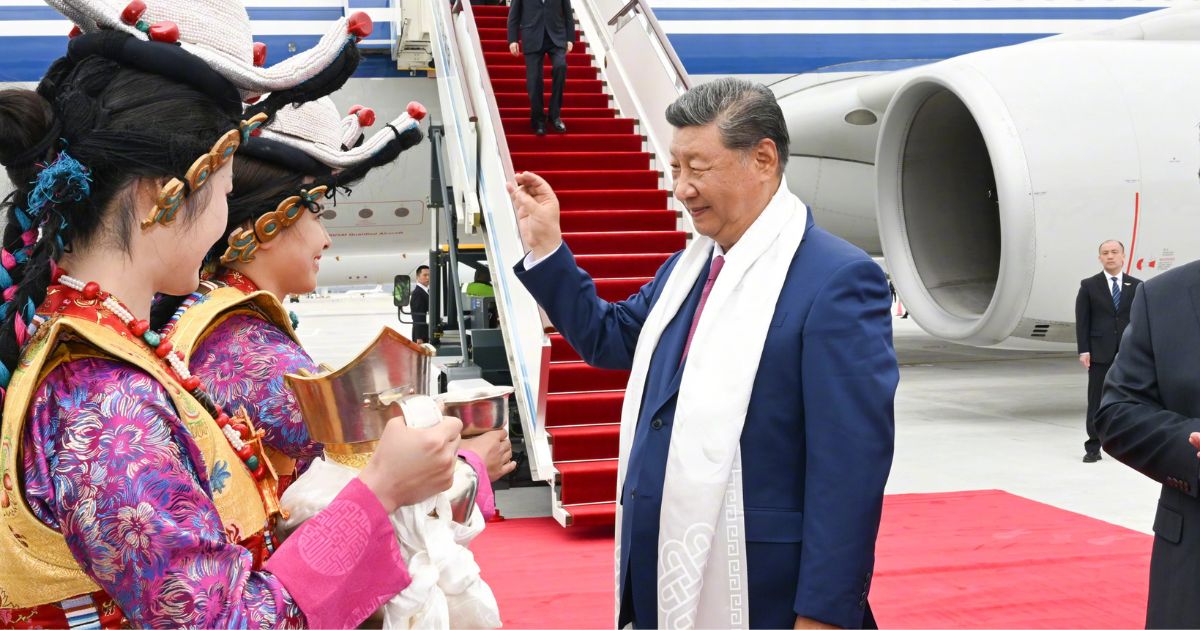
Xi’s Rare Visit to Lhasa
Chinese President Xi Jinping made his second visit as the nation’s supreme leader when he arrived in Lhasa on Wednesday to celebrate the 60th anniversary of Tibet being made an autonomous region. The milestone dates back to 1965, six years after the 14th Dalai Lama escaped into exile in India after a rebellion went sour. Tibet was made China’s fifth and last autonomous region, following Inner Mongolia, Xinjiang, Guangxi, and Ningxia.
The designation was meant to grant ethnic minorities like Tibetans greater autonomy in policy and religious affairs. Yet international human rights groups and exiled Tibetans continue to describe Beijing’s rule as “oppressive,” an accusation China firmly rejects.
Xi’s Message: Stability and Control
In his address to high-ranking Tibetan officials, Xi emphasized that the region’s governance hinges on “political stability, social stability, ethnic unity, and religious harmony.” Xi reiterated the requirement for Tibetan Buddhism to adjust to China’s socialist system, emphasizing the Communist Party’s long-held position of religious and cultural incorporation.
Xi’s previous trip to Tibet in 2021 was viewed by outside observers as a symbolic display of the Party’s confidence in maintaining order in a region historically marked by dissent. Protests in 2008, followed by a wave of self-immolations, remain etched in global memory as stark reminders of Tibet’s resistance to Chinese rule.
Strategic Importance and Regional Tensions
Apart from symbolism, Tibet is strategically very important to Beijing. The Himalayan region shares borders with India, a nation which has had China facing repeated confrontations. The most serious ones in recent years were in 2020, with casualties on both sides and putting a strain on bilateral relations.
Xi’s latest visit coincided with a rare trip by China’s top diplomat Wang Yi to India, signaling attempts to rebuild damaged relations. However, Tibet remains a sensitive flashpoint. China’s new mega hydropower project in the region has already raised concerns in New Delhi over its impact on downstream water flows.
Xi justified the project as crucial to China’s carbon-cutting goals while vowing to protect Asia’s so-called “water tower.” The hydropower drive is also a sign of Beijing’s wider ambitions to tap Tibet’s vast natural resources, especially its enormous hydropower reserves.
ALSO READ: China to Unveil Hypersonic Weapons at Massive WWII Anniversary Parade in Beijing
Looking Back and Ahead
Xi was joined in Tibet by senior Party leaders Wang Huning and Cai Qi, underscoring the political weight of the anniversary. The last top-level visit to the region before Xi’s 2021 trip was made by Jiang Zemin in 1990. For the 50th anniversary in 2015, Yu Zhengsheng, then one of the country’s most senior leaders, represented Beijing.
This year’s anniversary trip seems intended not just to commemorate Tibet’s official status but also to reaffirm Beijing’s tightening hold on a region at the heart of both its internal cohesion and foreign policy dilemmas.