
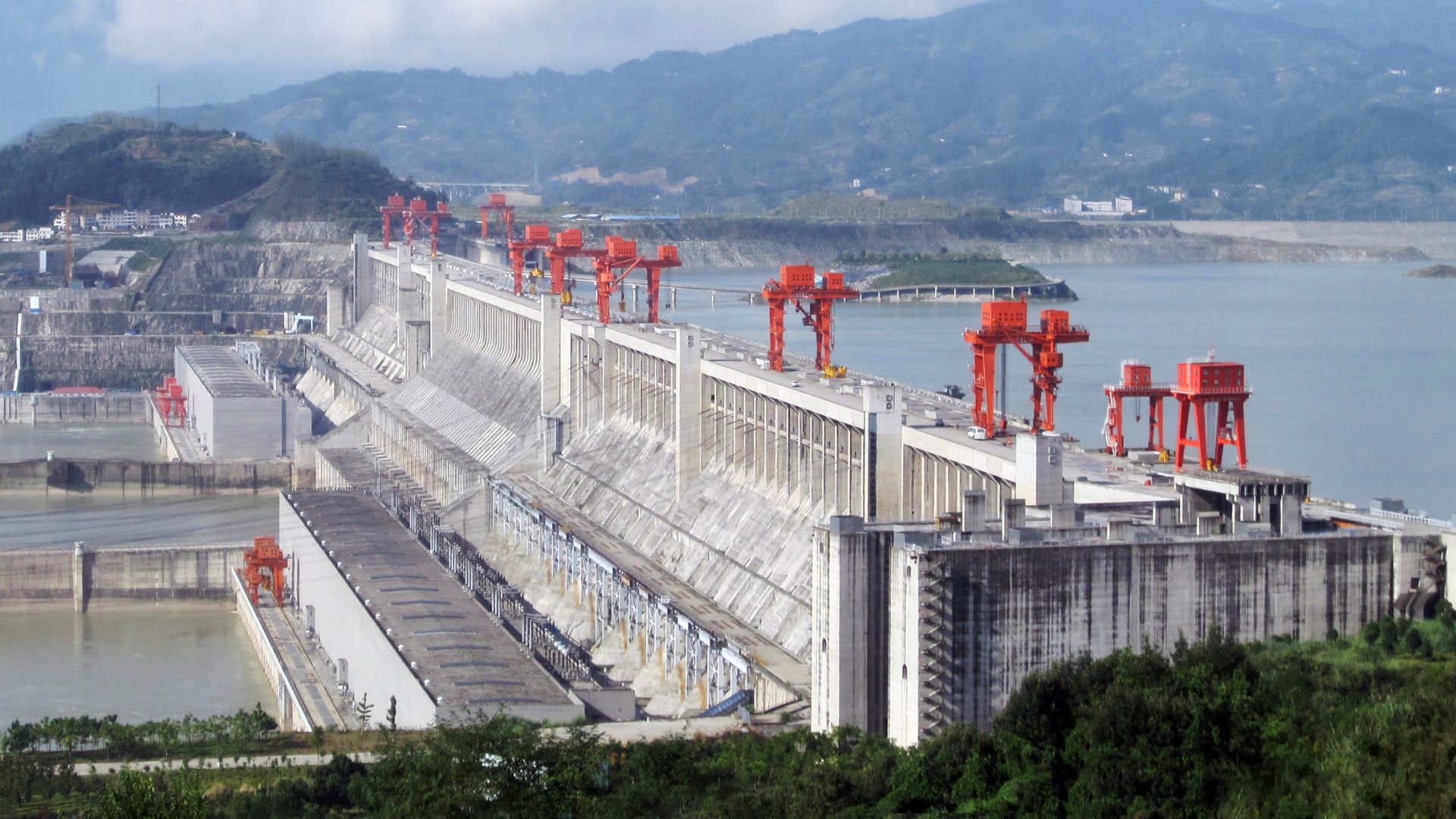
In an ambitious bid to revive river habitats, China has removed 300 of 357 dams and closed 342 of 373 small hydropower installations on the Chishui He, known as the Red River, a major tributary supplying the upper Yangtze.
Spanning more than 400 km across Yunnan, Guizhou, and Sichuan provinces in southwestern China, the Red River has been the focal point of a massive ecological restoration program launched in 2020.
This push, as reported by Xinhua and quoted by the South China Morning Post (SCMP), is a dramatic turnaround from decades of untrammeled hydropower development.
Restoring Fish Migration and River Health
Authorities outlined why demolishing these facilities was essential in order to restore migration routes for fish, restore river flow patterns, and restore long-disrupted spawning grounds.
The Yangtze, Asia’s longest river, underpins large portions of China’s ecological balance, agriculture, and economy. Yet decades of infrastructure development, including the aggressive construction of dams caused widespread devastation to aquatic habitats.
The Red River, a haven previously for rare native fish in the upper Yangtze, became extremely fragmented. Downstream flows were reduced, parts left dry, and critical links between breeding and non-breeding habitats were destroyed, annihilating local fish life.
Yangtze Sturgeon: At the Centre of This Re-Think
One driving force behind China’s extreme actions was the fate of the Yangtze sturgeon, a prehistoric fresh-water creature named ‘extinct in the wild’ in 2022 by the International Union for Conservation of Nature. The symbolic loss came on the heels of the previous extinction of the Chinese paddlefish.
The downfall of the sturgeon began in the 1970s as a result of overfishing, damming, and habitat loss. Species of sturgeon hadn’t been found naturally hatching their offspring in the Yangtze since 2000.
However, China’s efforts at rehabilitating the Red River have already yielded encouraging results. Researchers from the Chinese Academy of Sciences’ Institute of Hydrobiology released two batches of Yangtze sturgeon into the river in 2023 and 2024. The fish took to the wild well.
By April of 2025, scientists released 20 sturgeon adults into a part of the Red River in Guizhou to experiment whether they could breed. “By mid-April, they had developed natural spawning behavior and were successfully hatching fry,” reported Liu Fei, who works at the Institute of Hydrobiology, in an interview with SCMP.
This proved that conditions were now good enough to accommodate the life cycle of one species that was thought to be lost.
Changing Gears to Ecology
In the words of Zhou Jianjun, a professor of hydraulic engineering at Tsinghua University, taking down a dam is not necessarily about dismantling it. Rather, the emphasis is on stopping the generation of electricity and adjusting control of the water to meet environmental demands.
“The most important thing is not whether the facilities are still in place, but that, once power generation ceases, the means of water control can be adjusted to serve ecological purposes,”
Zhou said to SCMP. His words underscore China’s changing strategy from river management led by infrastructure to policies favouring the health of ecosystems.
Indications of Biodiversity Recovery
Institute of Hydrobiology monitoring data have revealed a definite increase in fish species diversity along parts of the Red River.
This surge is not specific to sturgeon; other endangered fish, amphibians, and invertebrates are also coming back. With most small hydropower plants shut down, natural water levels, sediment flow, and migration corridors are slowly returning.
A wider overview from the Chinese government in August 2024 confirmed that aquatic biodiversity throughout the Yangtze basin had measurably increased.
Officials also noted that harmful activities such as sand mining, which had long disrupted fish feeding and spawning, had declined.
Water quality in major sections of the Yangtze and its tributaries, such as the Red River, was graded ‘excellent’.
Part of a Greater Yangtze Strategy
The Red River project is part of China’s broader vision to restore the Yangtze River Economic Belt. Central to this has been the 10-year fishing prohibition imposed in 2020, prohibiting commercial fishing in the main stem and important tributaries of the river to assist in recovering fish populations.
Tighter hydropower oversight also plays a big role. By the end of 2021, Sichuan province alone had taken corrective steps on 5,131 small hydropower sites, shutting down 1,223 of them, SCMP reported. At the same time, Beijing has cracked down on sand mining in ecologically sensitive areas.
Balancing Energy and Environment
While China is still the globe’s largest producer of hydropower and small hydro plants used to be touted to power rural areas, they were constructed with minimal environmental study.
By tearing down those facilities along the Red River, Beijing is sending a signal, a change for the first time, one in which long-term ecological well-being takes precedence over short-term generation, at least in vulnerable areas.
This doesn’t mean China is abandoning hydropower altogether, but it does show a willingness to pull back in places where biodiversity loss has become too severe to ignore.