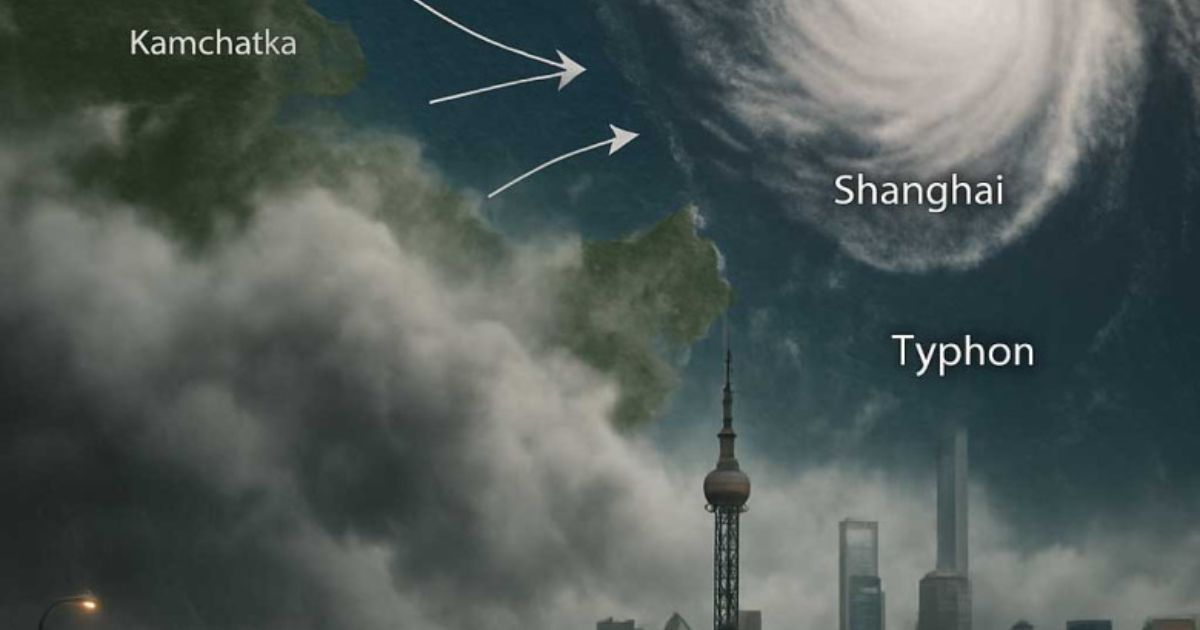
China was hit by twin natural disasters on Wednesday as Typhoon Co-May lashed the area near Shanghai just hours after a powerful earthquake off Russia’s Kamchatka Peninsula sent Pacific-wide tsunami warnings. The government reacted quickly, evacuating more than 280,000 residents of coastal areas in and around Shanghai, suspending construction, and closing operations at the busiest port in the world.
In addition, the tsunami warning also triggered extra alarms across the Pacific, ranging from Hawaii to Japan, posing an unusual and multi-faceted challenge for emergency responders.
Co-May Typhoon Makes Landfall
Typhoon Co-May made landfall in Zhoushan, a major port city in Zhejiang province, with sustained winds of 83 km/hr at its centre. The typhoon dumped torrential rains and powerful gusts on the eastern seaboard. Forecasters predicted a possible second landfall nearer Shanghai later in the day. Officials responded by issuing an orange alert — China’s second-highest warning level — and evacuating at least 282,800 individuals by 10:00 am, state broadcaster CCTV reported.
Shanghai cancelled scores of flights and closed public life. Governments cancelled all construction and closed schools. The Yangshan Port of Shanghai — the world’s largest container port — also suspended operations as a precautionary measure.
Earthquake Triggers Tsunami Across Pacific
While China was battling Co-May, a powerful 8.8-magnitude earthquake struck off Russia’s Kamchatka Peninsula at 8:24 am local time (2304 am GMT). The tremor, among the top 10 largest ever recorded globally, triggered tsunami waves of up to four meters (12 feet) across the Pacific Ocean. Alerts were issued in Japan, Hawaii, and other island nations, while evacuation protocols kicked in.
Although Russia’s Far East is remote, the effect of the quake travelled far. Officials activated tsunami warnings from Tokyo to Honolulu. Waves rolled into coastal communities hours later, heightening the state of emergency in the region.
China’s Emergency Systems Tested Twice
China’s disaster management machinery was tested twice by overlapping catastrophes. It is complex enough to coordinate mass evacuations during a typhoon. But at the same time, issuing tsunami alerts added to the weight on local authorities.
In Shanghai, shelters were filled in a matter of hours. Flood barriers were strengthened overnight. Meteorologists were juggling storm following with monitoring coastal waves. Weather station, port authority, and evacuation coordinator communication intensified.
Although typhoons are a familiar seasonal occurrence in China, the unusual juxtaposition with a major earthquake event stretched the coordination of real-time responses to their limits.
A Wake-Up Call for Coastal Megacities
This twinned disaster laid bare weaknesses in population-dense coastal metropolises such as Shanghai. While climate change increases the force of weather phenomena and tectonic hazards continue to be high along the Pacific Ring of Fire, cities are increasingly threatened by compound disasters.
Shanghai acted quickly, but the experience highlighted the importance of multi-layered preparedness — from earthquake-proof infrastructure to coordinated early warning systems for typhoons as well as tsunamis.
China’s response to the Co-May and the Pacific earthquake will inevitably become a model for similar situations in the future where climate and seismic threats overlap.