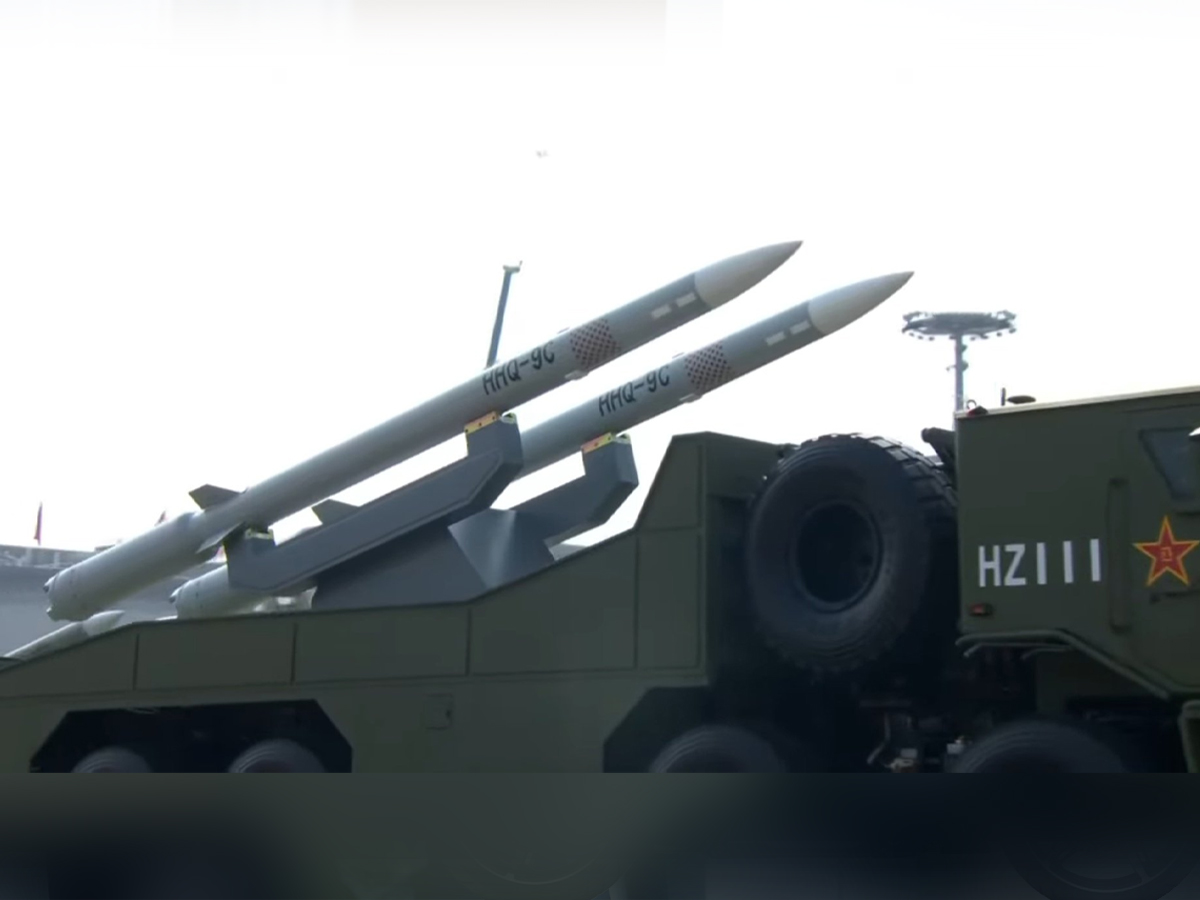
China recently displayed its HQ-9C missile during the Victory Day Parade, showing off its growing military strength. The missile is fast, advanced, and designed to intercept many types of aerial threats, making it a key part of China’s defence technology.
But beyond the parade, the missile has faced challenges in real situations. When Pakistan used the HQ-9P to counter India’s Operation Sindoor attack, it failed to fully protect Pakistani airspace from Indian attacks. This was another version of HQ-9C, which was specially designed for Pakistan.
#WATCH | HQ-9C missiles seen in China’s Victory Day Parade, in Beijing.
A version of the HQ-9 missile system has been acquired by Pakistan for its defence network. It purportedly saw action as per Pak media in Operation Sindoor, however, failed to protect Pakistani airspace… pic.twitter.com/18LiAGinCb
— ANI (@ANI) September 3, 2025
This shows that even advanced weapons can have limits in real combat. The missile, also part of China’s export program, is both impressive and controversial, making it widely discussed in recent years.
Deployment of HQ-9 Missile in Pakistan and Challenges
Pakistan bought the HQ-9P from China to improve its air defense. However, during Operation Sindoor in May 2025, the missile system faced real-world tests. India carried out precision strikes on terrorist targets in Pakistan.
Several media reports show that the HQ-9P failed to detect or stop Indian missiles like BrahMos, SCALP, and S-400. Experts believe this failure happened due to radar problems, older technology, and possible human mistakes.
ALSO READ: Trump Accuses India of Unfair Trade, But Harley-Davidson Exit Tells a Different Story
China exported the HQ-9C to Pakistan, which highlights the close defense ties between the two countries, and the deal strengthens Pakistan’s air defense and shows China’s influence in the global arms market. But the missile’s poor performance in Operation Sindoor may make other countries question Chinese weapons before buying them.
About the HQ-9 Missile
The HQ-9, also called Hong Qi-9 (Red Banner-9), is a long-range surface-to-air missile (SAM) developed by China Aerospace Science and Industry Corporation (CASIC). It combines technology from Russia’s S-300 system and possibly some ideas from the American Patriot missile.
The HQ-9 is designed to protect against a wide range of aerial threats, including fighter jets, bombers, cruise missiles, air-to-surface missiles, and tactical ballistic missiles, and even some of its versions can target stealth aircraft and have limited anti-ballistic missile capabilities.
ALSO READ: Jeffrey Epstein Case: US House Oversight Committee Releases Over 33,000 Pages
The missile can reach speeds of around Mach 4.2 and has a range of 120–300 km, with an estimated cost of $599 million per system.
HQ-9C has been exported to multiple countries. It is often shown in military parades and exhibitions, but there are few reports on how it has performed in real combat outside Pakistan. Analysts closely watch these deployments to assess the missile’s effectiveness.
China’s Victory Day Parade
China showcases its military might and technological prowess each year with its Victory Day Parade. China’s aim of modernizing its defense and demonstrating its power on the international scene is demonstrated by the display of the HQ-9C missile.