
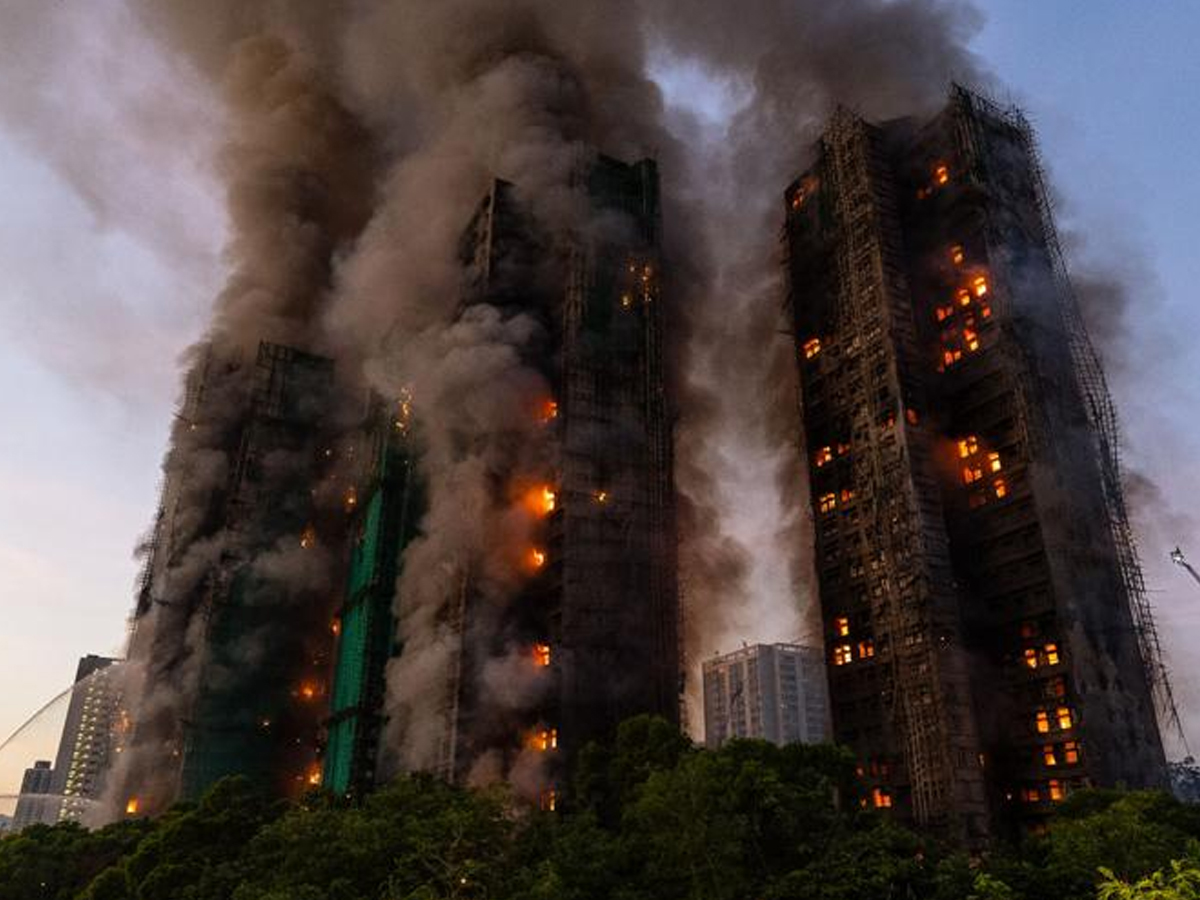
A massive fire tore through a large residential estate in Hong Kong’s Tai Po district, killing at least 44 people and leaving nearly 300 unaccounted for, police said Thursday. Flames engulfed multiple high-rise blocks at Wang Fuk Court — a dense housing complex housing over 4,600 residents — leaving survivors shaken and officials scrambling to rescue those still trapped.
The blaze broke out on Wednesday afternoon, but thick smoke, intense heat, and flammable materials made firefighting extremely difficult. By Thursday morning, crews had managed to bring the fire under control in four of the eight affected towers. But fire still raged in at least two towers, their bamboo scaffolding and construction mesh still visible, even as flames poured from upper floors and rescue operations continued.
Hong Kong Fire Tragedy: Unsafe Materials Under Scrutiny; Scaffolding, Foam Windows
Authorities suspect that the fire’s deadly spread was accelerated by unsafe building materials used during recent maintenance work. The towers were wrapped in bamboo scaffolding and covered with green construction mesh — a traditional but increasingly controversial method. Police also discovered that some windows were sealed with foam material, applied by a construction firm during renovation. Officials say the foam was highly flammable.
“We have reason to believe that the company’s responsible parties were grossly negligent, which led to this accident and caused the fire to spread uncontrollably, resulting in major casualties,” said senior police superintendent Eileen Chung. Three men tied to the construction company — two directors and one engineering consultant — have been arrested on suspicion of manslaughter.
The tragedy has drawn comparisons to other global disasters caused by flammable cladding or mesh materials. Critics have long warned that bamboo scaffolding and cheap construction sheeting pose serious fire risks.
Hong Kong Fire Tragedy: Horror, Chaos, and Search for Survivors
Eyewitnesses described a scene of sheer panic as flames spread rapidly across the towers. Many residents scrambled to grab belongings and flee. One 66-year-old occupant, who has lived in the complex for over 40 years, said he heard a loud boom around 2:45 p.m. and saw fire engulf a neighboring block. He rushed to pack his things, but still doesn’t know what to do next.
A 71-year-old resident, surnamed Wong, broke down when speaking to reporters — his wife remains unaccounted for. Others said they still can’t find friends or neighbors from adjacent blocks. Roads surrounding the estate have been closed. Over 900 residents remain in temporary shelters, and authorities confirmed that 279 people are still uncontactable.
Hong Kong’s leader, John Lee, said the government will prioritise extinguishing the fire, rescuing survivors, and caring for the injured. He promised a full investigation.
Hong Kong Fire Tragedy: Deadliest in Decades
The death count of 44 makes this the most lethal fire in Hong Kong since 1948, and surpasses the 1996 Kowloon commercial building blaze that killed 41 people. This tragedy has underlined long-standing concerns about fire safety in densely populated housing estates — especially those under renovation.
Many residents and social media users accused building management and authorities of negligence. A video circulating online showed construction workers smoking on the bamboo scaffolding while renovation work proceeded.
The use of bamboo scaffolding is being phased out in Hong Kong. In March, the government mandated that 50% of public works switch to metal scaffolding, citing safety concerns. However, it did not explicitly ban bamboo use — even though there have already been at least three fires involving bamboo scaffolding this year.
Fallout: Safety, Regulation and Political Understrain
Beyond loss of life, the disaster has revived public anger over the city’s housing policies — especially among those who feel long-term residents get short shrift. The tragedy comes just weeks before a city-wide legislative election, and social discontent is rising over safety, housing costs, and government accountability.
Wang Fuk Court, once part of a subsidised home-ownership scheme, had been under renovation recently. According to property-agency listings, the upgrade cost over HK$330 million (about US$42 million), with each flat paying between HK$160,000 and HK$180,000 in renovation fees. Some residents now say they fear their homes — and lives — were endangered for economic reasons.
What’s Next: Rescue, Investigation, Accountability
For now, emergency services continue to search for missing people and treat the wounded. The government has pledged support for survivors and launched what promises to be a wide-ranging investigation.
But many residents want more. They are calling for stricter enforcement of building safety standards — especially a full ban on flammable scaffolding and mesh materials in high-rise housing. Some warn that unless the government acts quickly, Hong Kong risks repeating the nightmare all too soon.
The wounds from this disaster will run deep. The city now waits for answers — and justice.