China has openly declared that it, not the Dalai Lama or his institution, will decide who the next Dalai Lama will be. A senior Chinese Communist Party official in Tibet said on Tuesday that the search and recognition of the Dalai Lama’s reincarnation will be carried out within China and must be approved by the central government.
This comes despite the Dalai Lama’s repeated assertions that his reincarnation will occur outside Chinese borders and be overseen by a non-profit institute he has established. The statement marks a renewed push by Beijing to bring Tibetan Buddhism under state control and raises fears of a deeper cultural and spiritual hijack in the name of religious tradition.
At a press conference held on Tuesday, Gama Cedain, the deputy secretary of the Chinese Communist Party (CCP) committee in Tibet, made Beijing’s position clear. He said the “central government has the indisputable final say” in identifying the next Dalai Lama. Cedain insisted that the government would follow what he called “strict religious rituals and historical customs” during the process.
ALSO READ: PM Modi to Visit China for SCO Summit, First Trip Since Ladakh Standoff
According to him, the Dalai Lama has never had the authority to choose his successor. “The reincarnation has never been decided by the Dalai Lama himself,” he said.
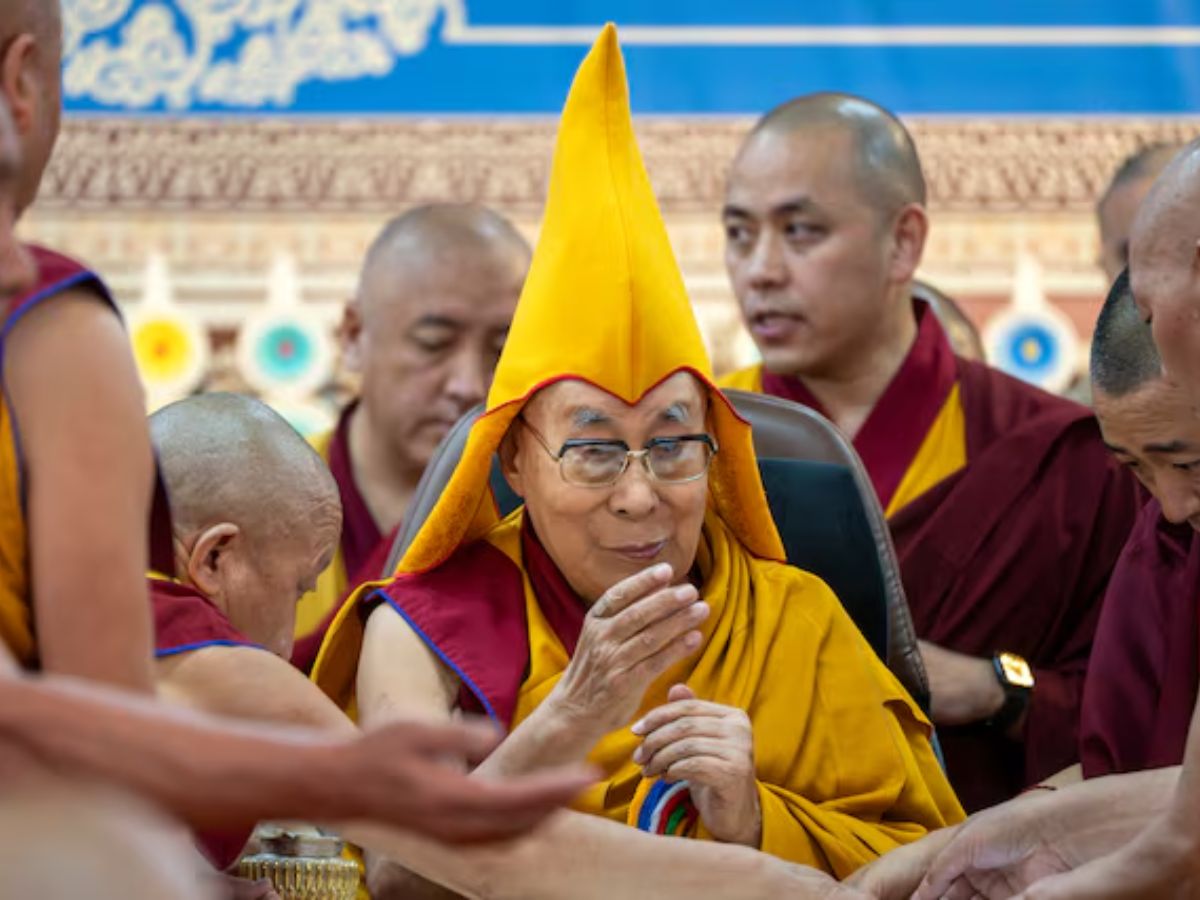
This contradicts recent statements made by the 14th Dalai Lama, who turned 90 last month. At his birthday celebration, he told followers that he would be reincarnated. He added that a non-profit institution he set up would manage the process of identifying the new incarnation.
Dalai Lama Rejects Beijing’s Role
The Dalai Lama, awarded the Nobel Peace Prize and revered by millions of Tibetans, has long rejected China’s authority over spiritual matters. He has repeatedly said that his reincarnation will not be born in China.
He is concerned that Beijing will appoint a political puppet to succeed him. This is a legitimate fear. A six-year-old boy who had been selected by the Dalai Lama to be the Panchen Lama, the second-highest spiritual person in Tibetan Buddhism, was abducted by the Chinese government in 1995, but later, Beijing replaced him with a candidate, and this decision was strongly opposed by Tibetan communities.
ALSO READ: Trump’s Tariff Gambit: Forcing a Rethink in India-China Ties?
Battle for Legacy and Identity
This issue is not only about religion, but it is a component of a broader fight for Tibetan cultural identity and spiritual autonomy. China sees the Dalai Lama as a separatist and Tibetan Buddhism as a political threat.
By controlling the reincarnation process, the Chinese government seeks to mitigate the threat & gradually turn religious authority into a state-approved narrative.
However, Tibetans still oppose such actions, and many people think that any attempt by Beijing to select the next Dalai Lama will be strongly disapproved of by Buddhists worldwide.
ALSO READ: China Experts Describe US-Pakistan Relations as Brief Geopolitical Distraction
Global Ramifications of a Politicised Reincarnation
If Beijing proceeds with naming a Dalai Lama approved by the government, it could establish a risky precedent, which could result in effects that reach beyond Tibet or China.
The recognition of two rival Dalai Lamas could cause dissension in countries like India, Nepal, Mongolia and the Buddhist community worldwide. Now that the current Dalai Lama lives in exile in India, this might affect the India’s relations with China.