
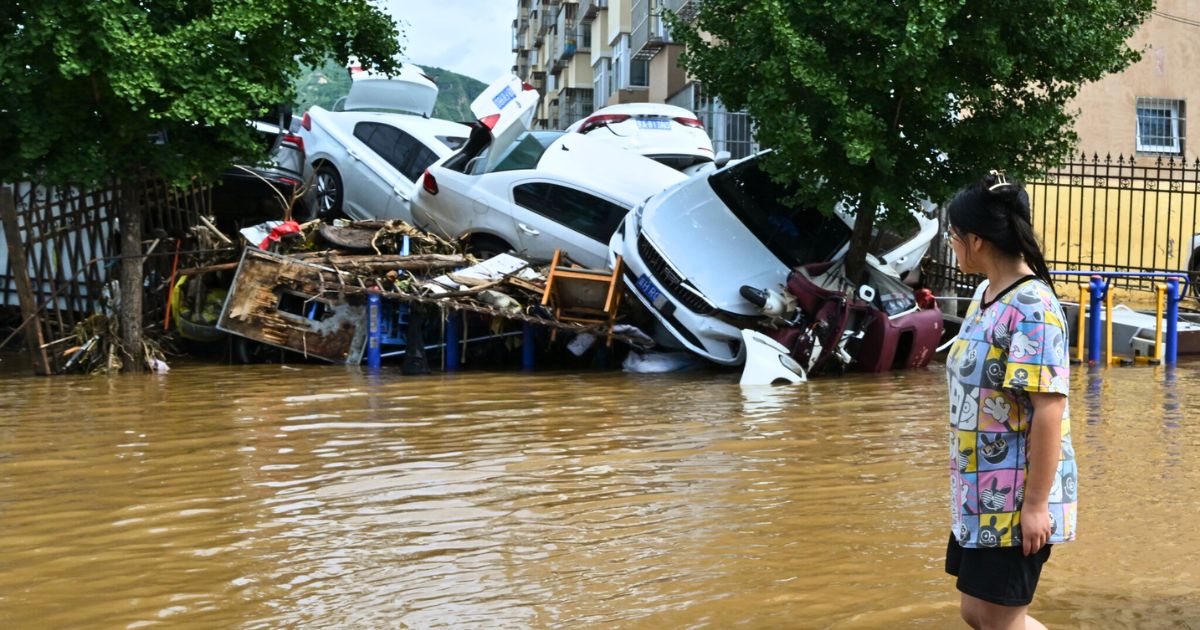
Beijing was ravaged by torrential rain that poured a year’s worth of water in just under a week, killing a minimum of 30 and displacing more than 80,000 residents. The disaster hit hardest in the hilly north around the Great Wall and ripped through villages, breaking roads, downing power lines, and cutting off communications in more than 130 villages.
While the city struggled to keep up, authorities painted Beijing as a rain “trap,” raising fundamental questions about China’s climate preparedness and urban planning.
Mountains, Rain, and a City Overwhelmed
Huge rainfalls started on July 23 and reached their peak on Monday night, putting Beijing’s emergency services under the utmost pressure. Miyun district was hit the worst, seeing as much as 573.5 mm of rain, almost equivalent to Beijing’s annual average of 600 mm. At least 28 died in Miyun and two in the neighbouring Yanqing, the state media reported.
The hardest hour-long deluge—95.3 mm—happened Saturday in Huairou, a mountainous region in north-eastern Beijing. Topography in the area was to blame. Surrounded by mountains to the west and north, water-laden air had nowhere to go but upwards, making the storm heavier and sealing the city under constant rain.
Shattered Lives and Rising Losses
Miyun is now reduced to rubble. Bridges are destroyed. Cars are wrecked. Pipelines are ruptured. Residents say the flood happened in an instant and was merciless. “The flood came instantly, you just had no buffer,” said Zhai, 33, a grocery shop owner whose business is now under 1.5 metres of water. Everything in her food and drink was ruined.
Next door, Liu’s restaurant is still covered in mud, with fridges and furniture probably irreparable. Her husband Yang estimated their losses at more than 100,000 yuan ($14,000). “It’s heartbreaking,” he said.
Over 80,000 were evacuated in Beijing. Flights were held up for hundreds. Trains were canceled. And with no electricity or mobile reception, villagers posted onto Weibo, begging for assistance. “The water is still coming… I am unable to contact my family!” wrote one of the users.
Climate Warning in a ‘Dry’ North
This tragedy is not an isolated incident. It was in 2023 when rainstorms claimed 33 lives in Beijing. The same summer saw the city of Xingtai in Hebei province logging more than 1,000 mm of rain—twice its annual average within two days.
As climate scientist Xuebin Zhang explained, 80–90% of the entire year’s rain fell in Beijing in just a few days. “Very few systems are designed to cope with such a high amount of rainfall,” he said. Zhang identified climate change as a main culprit, particularly for China’s generally dry north.
China Faces Hard Climate Questions
The sheer volume and number of these severe weather events have raised anew questions about the way that China constructs and defends its cities. Much of the urban areas—particularly in the north—are not designed to handle this much water this fast. Experts are calling on Beijing to upgrade stormwater infrastructure, update their disaster planning, and confront climate threats directly.
The ministry of emergency management described the response to the disaster as “complex and severe,” but residents complain aid is too slow in coming. The increasing trend of devastation hints at the necessity of deeper reform. Beijing’s “trap” of rain is more than a fluke. It’s a climate signal. If nothing is done, these kinds of disasters could be the new normal in China’s northern cities.