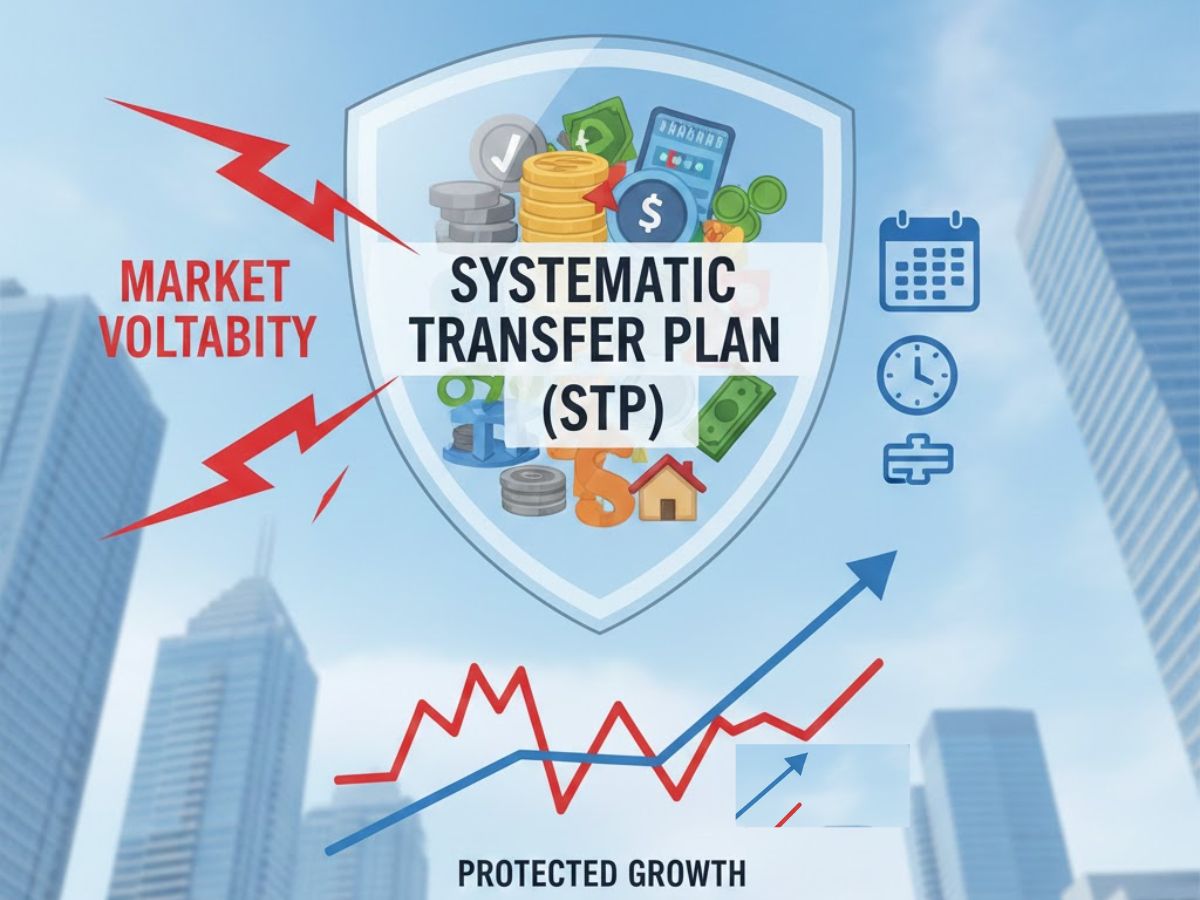
Market timing is a common worry for every investor. What if you invest a large sum right before a market dip? A Systematic Transfer Plan helps move your money between funds in a planned, step-by-step manner instead of transferring the full amount at one time.
What is a Systematic Transfer Plan (STP)?
Mutual funds have a feature called a Systematic Transfer Plan that allows you to automatically move a predetermined sum of money from one fund (the source fund) to another (the target fund) at regular intervals. Think of it as putting your investments on autopilot. Instead of investing a full lump sum from a debt fund into equity at once, you can follow a planned transfer. For example, moving ₹20,000 monthly for a year allows a smoother and safer transition.
How Does an STP Help You Avoid Market Volatility?
The main benefit of an STP is that it helps handle market ups and downs through rupee cost averaging. By transferring a fixed amount regularly into another fund, you buy more units when prices fall and fewer when prices rise, which balances your overall cost. For example, if you want to invest in a mid-cap fund but fear high market levels, you can first place ₹5 lakh in a stable debt fund. Then, diversify your investment over several market levels and lower risk by transferring ₹50,000 each month into the mid-cap fund via a STP.
What Are the Key Advantages of Using an STP?
Beyond managing volatility, STPs offer several tangible benefits:
Tax Efficiency: Transfers under an STP are not treated as taxable redemptions right away. This prevents an immediate capital gains tax on units sold from the source fund, supporting smarter tax management.
Enforced Discipline: The automated schedule prevents you from spending the redeemed money impulsively. It instills a disciplined investing habit by ensuring funds are systematically redeployed according to your plan, not your emotions.
Strategic Asset Reallocation: It is an excellent tool for gradually shifting your portfolio allocation. You can methodically move from conservative investments (like debt funds) to growth-oriented ones (like equity funds) or vice-versa without taking a large, timed bet.
FAQs on Systematic Transfer Plans (STP)
Q: Is STP good for new investors?
A: Yes, it is ideal for beginners who are unsure about market timing, as it lets them invest a lump sum in a debt fund and move gradually into equity.
Q: Do I pay tax on an STP?
A: There is no tax associated with the transfer from the source fund. However, depending on your holding duration, capital gains tax will be applied when you eventually redeem units from the target fund.
Q: Can I stop or modify my STP anytime?
A: Typically, yes. Most fund houses allow you to pause, modify the amount, or stop the STP instructions at any time, offering flexibility.
Q: What is the difference between an STP and a SIP?
A: Fresh funds from your bank account are invested into a fund through a SIP (Systematic Investment Plan). An STP moves money that has already been invested in one mutual fund to another.
Also Read: PM Modi Conferred Ethiopia’s Highest Honour in Landmark Visit, Abiy Ahmed Drives Him Personally