
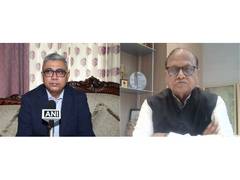
New Delhi [India], July 22 (ANI): Indian pharmaceutical industry leaders expressed strong reservations regarding proposed US tariffs on generic drugs, stating that absorbing rates up to 200 per cent remains impossible for manufacturers operating on thin margins.
Earlier in the day, US President Donald Trump announced on Truth Social that effective August 1, 2026, all generic drugs imported into the United States will face zero per cent tariffs for two years. Under the plan, tariffs will subsequently rise to 100 per cent in the third year and reach 200 per cent from the fourth year onward. The administration noted that the measure aims to shift generic pharmaceutical production back to the US, while existing policies on patented, branded, and innovative drugs remain unchanged.
Reacting to the timeline, Pharmaceuticals Export Promotion Council (Pharmexcil) Chairman Namit Joshi highlighted that building the necessary infrastructure for an ecosystem within two years is not realistic.
“From our perspective, it doesn’t look like that it will be possible. Because to make any pharmaceutical generic ecosystem, it takes a minimum of 4-5 years. If you impose tariff within 2 years, without creation of the ecosystem, the possibility is low,” Joshi said.
Addressing the direct impact on prices, Joshi stated that domestic manufacturers lack the financial buffer to cushion such high duties.
“Even if such a possibility arises, the Indian industry does not have that much scope or margin. Right now, we are operating on very thin margins, so we will have severe limitations. We won’t be able to absorb this tariff; we will have to transfer it. Either the tariff will get passed on, or we won’t be able to supply at all. We don’t have many options,” he explained.
“The entire industry is saying that 200% is completely out of the question, and even 100% is extremely difficult for any pharmaceutical manufacturer to absorb,” Joshi added.
Indian Pharmaceutical Alliance Secretary General Sudarshan Jain noted that the two-year window leaves room for continued dialogue with US authorities, stressing that generic medicines provide healthcare and medicine security to American citizens.
“This is going to be applicable only after two years, the 100% tariff. It is not applicable from today. As all of us are aware that India has been a consistent supplier of medicine to the US. Around 90% of the medicines in the US are genetic and they cost only 13% of overall healthcare expenditure and 10% are innovative drugs which cost 87%. So from a cost point of view, the medicines provide healthcare security and medicine security to the US citizen,” Jain said.
Jain pointed out that Indian firms already maintain over 40 manufacturing facilities in the US that generate employment across manufacturing, research, and supply chain operations.
“India is very committed to the US market. And already during the last one year, Indian companies have invested in the US. So there is a constant investment which is taking place in the US. So our discussions are constantly engaged in the discussion with the US administration,” he noted.
He further emphasized that manufacturing low-cost products locally in the US presents significant economic hurdles.
“And the position which we are taking, low price products is not economically worthwhile to produce in the US because cost of manufacturing in the US will be 5 to 10 times for many of the products. It may be possible to manufacture oncology product, high value product in the US, respiratory products, and Indian companies are examining what can be done and manufactured in the US,” Jain stated.
“For deciding the manufacturing, it is important that there has to be economic viability, has to be adequate demand, and there has to be a regulatory clearance at a faster level. Our discussion is going on because for us, consistency of availability of medicine is very important from US citizen’s point of view,” he concluded. (ANI)
(The article has been published through a syndicated feed. Except for the headline, the content has been published verbatim. Liability lies with original publisher.)