
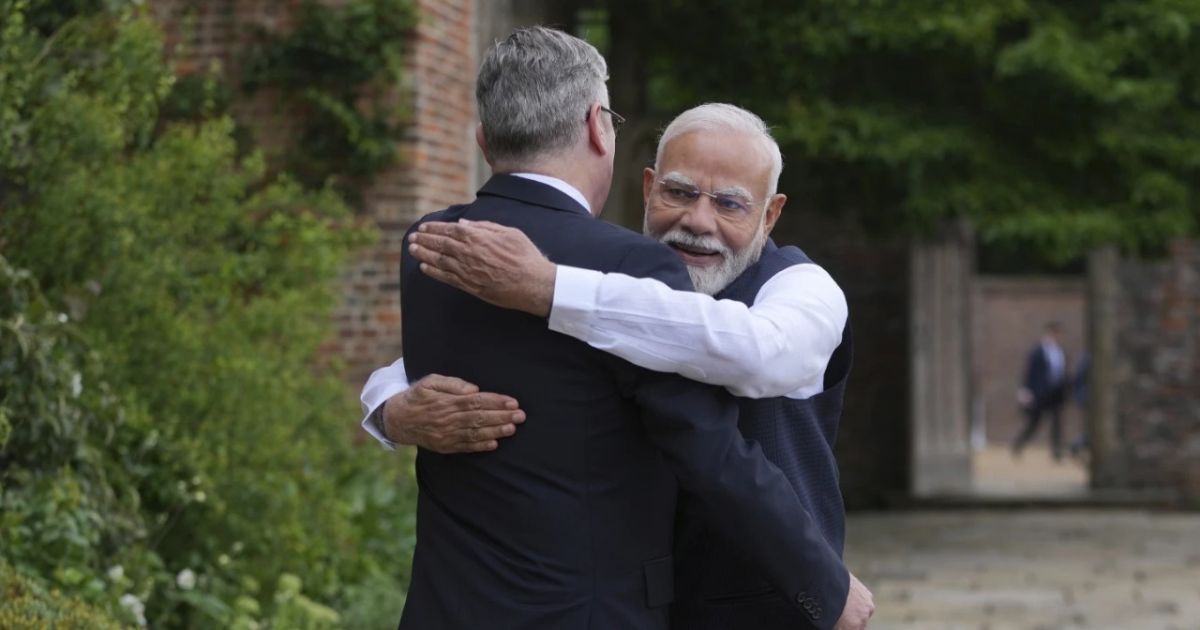
In a landmark shift aimed at boosting bilateral economic cooperation, the UK government announced that India’s average tariff on British goods will fall sharply from 15% to just 3% under the new India-UK Free Trade Agreement (FTA), set to be formally signed on Thursday.
It is projected that this substantial reduction in tariffs, especially on high-value British goods, will eventually lead to a 60% increase in UK exports to India, or an additional $20 billion (£15.7 billion). By 2040, bilateral trade is expected to reach $34 billion (£25.5 billion), with the agreement also aiming to boost overall bilateral trade by about 39% when compared to scenarios without the agreement.
“This deal marks a new era of trade liberalization and mutual prosperity,” said a UK government statement released ahead of the signing ceremony.
India Sheds ‘High-Tariff’ Tag
India, often criticized for steep import duties—most notably by US President Donald Trump—has in recent years made efforts to lower trade barriers for strategic partners. The most recent free trade deal reflects New Delhi’s efforts to facilitate trade and increase export competitiveness, particularly in labor-intensive industries like textiles, leather, and manufacturing.
A wide number of topics are covered under the agreement, such as government procurement, innovation, goods and services, and intellectual property rights.
Big Gains for British Firms
As many as 26 British companies have already secured new business deals in India as a result of the agreement. Key among them are aerospace giants Airbus and Rolls-Royce, which will begin delivering aircraft—with over half powered by Rolls-Royce engines—to major Indian airlines under contracts worth £5 billion.
The pact also promises to make it easier and cheaper for the UK to import Indian products, thanks to liberalized tariffs on Indian goods. This includes potential cost savings for UK businesses importing components in sectors like advanced manufacturing, luxury goods, and consumer durables.
99% Tariff Lines Eliminated for India
According to India’s Ministry of Commerce and Industry, the deal ensures tariff elimination on 99% of tariff lines, which covers nearly the entire amount of trade between the two countries. This gives Indian exporters a lot of opportunities in important industries, including processed foods, textiles, jewelry, gems, and medicines.
Social Security Pact Finalised, BIT Still Pending
In addition to the FTA, both countries have concluded negotiations on the Double Contribution Convention pact, a long-awaited social security pact. This proposal will allow Indian professionals temporarily employed in the UK to avoid making two contributions to the social security coffers, which is estimated to benefit thousands of computer and finance personnel.
Nonetheless, the FTA’s implementation is anticipated to be accompanied by ongoing Bilateral Investment Treaty (BIT) negotiations.