
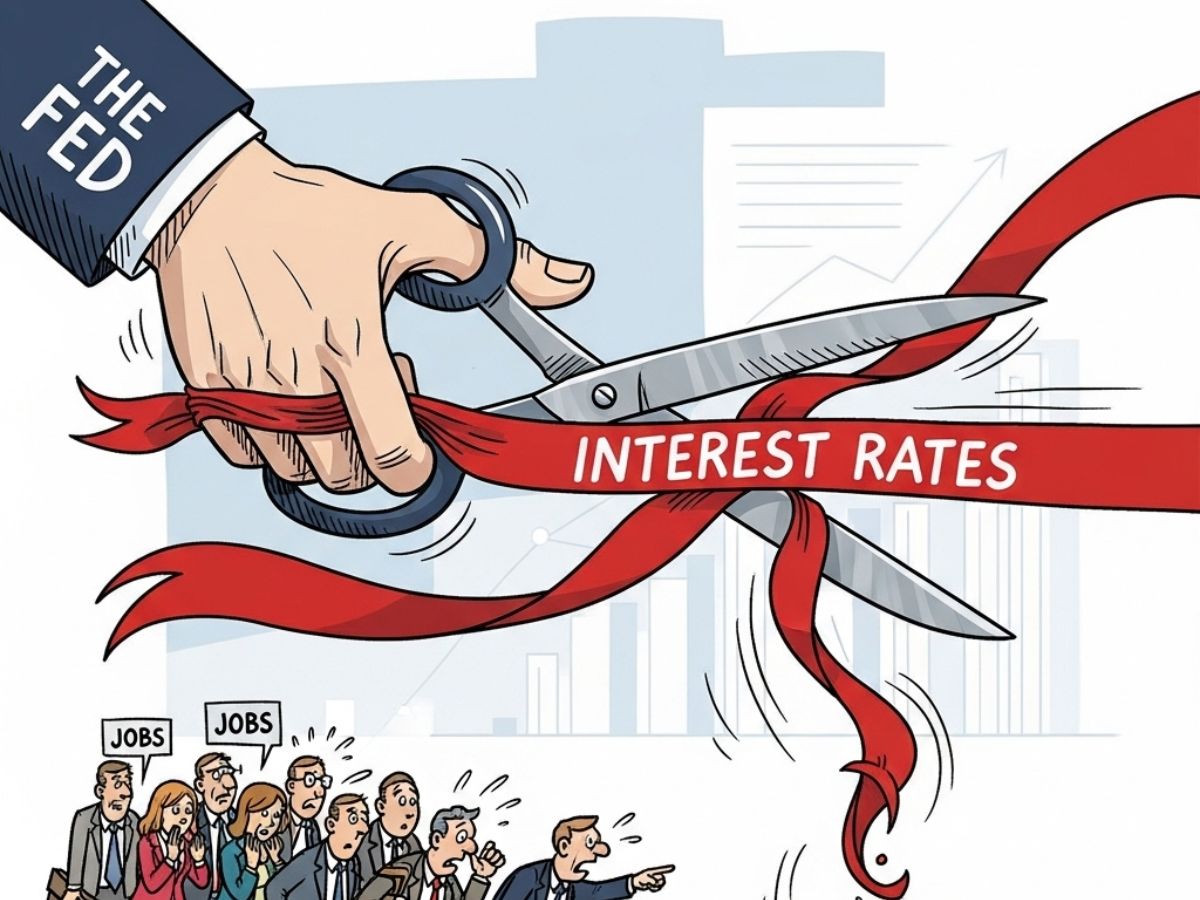
The U.S. Federal Reserve initiated its first interest rate cut of the year, reflecting a notable policy shift. The central bank has taken this step to shield the labor market, signaling a fresh chapter in its struggle to balance economic growth and inflation.
What Did the Federal Reserve Decide?
The Federal Open Market Committee (FOMC) voted 11-1 to cut the benchmark lending rate by 25 basis points. The target range for the key federal funds rate is now 4.0% to 4.25%. After maintaining rates stable at a 23-year high for a long time, the decision represents a significant shift.
Why Cut Rates Now?
The central bank’s statement revealed a growing concern about the health of the job market, a key pillar of the economy.”Downside risks to employment have grown,” the Fed said clearly. This worry stems from two important findings:
- Slower Job Gains: Data indicates that the pace of hiring has decelerated.
- Rising Unemployment: The unemployment rate has begun to inch up from its historically low levels, though it “remains low.”
- This emphasis on job protection is a minor but significant change in focus since inflation, although still a worry, appears to be abating.
What About Inflation and Growth?
The Fed acknowledged that inflation “has moved up and remains somewhat elevated,” preventing it from taking more aggressive action. The bank’s most recent economic forecasts, however, present a more complex picture:
- Inflation Unchanged: The Fed maintained its underlying inflation estimate of 3.1% for the end of 2025, unchanged from its June forecast.
- Growth Upgraded: Surprisingly, the Fed increased its growth forecasts. It now expects U.S. GDP to grow by 1.6% in 2025 (up from 1.4%) and 1.8% in 2026 (up from 1.6%). This implies that even when interest rates start to decline, they see a path where the economy keeps growing.
What’s Next for Interest Rates?
All eyes were on the infamous “dot plot,” which charts individual officials’ interest rate projections. The median forecast points to:
- Two more 25-basis-point rate cuts before the end of 2025.
- An additional quarter-point cut in 2026.
This provides a roadmap, indicating that the Fed is embarking on a cautious, gradual easing cycle.
Was the Decision Unanimous?
The vote was not without dissent. The sole opposition came from Stephen Miran, a new Fed Governor appointed by former President Trump. Miran voted against the decision, preferring a larger, more aggressive rate reduction of half a percentage point.
His dissent points to the chance of internal debate as the Fed guides the economy through this critical transition.
Also Read: Trump’s Return, Gaza Famine, and Ukraine War Dominate Tense UN Assembly
How Did the Markets React?
The immediate market reaction was mixed, reflecting the complex signals:
- U.S. Treasuries rallied (yields fell), a typical reaction to rate cuts.
- The U.S. dollar extended its drop against other currencies.
- The S&P 500 initially jumped but then reversed gains, indicating investor uncertainty about the pace of future easing and the underlying reasons for the cut.
The Fed’s move is a preemptive strike against economic weakness, setting the stage for a new phase of monetary policy focused on sustaining the expansion.