
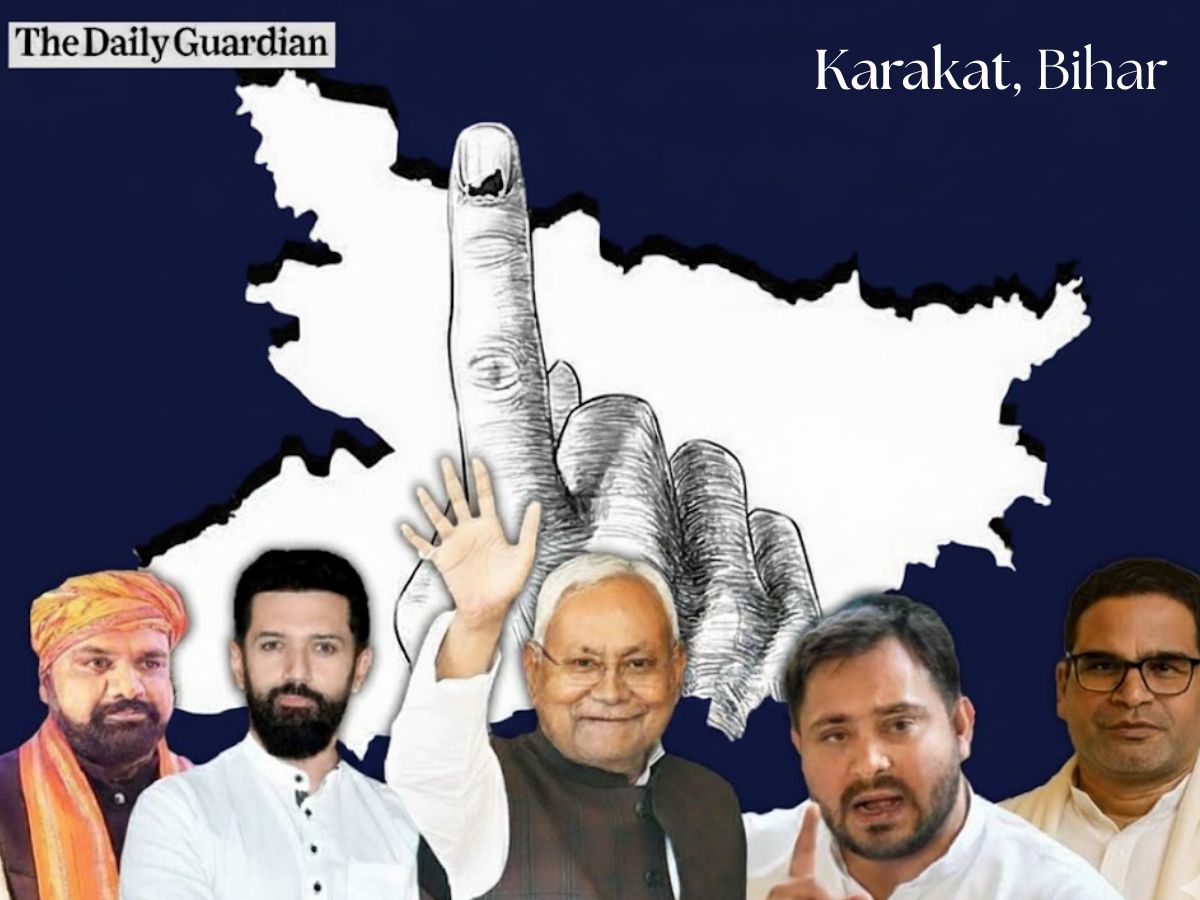
The 2025 Bihar Assembly elections have already geared up as voters are up to decide on key issues such as infrastructure growth, job creation, school standards, healthcare access, and safe public order. With 243 seats up for grabs, every constituency matters — and political parties have already announced their candidate lists in earnest. A party or alliance must secure at least 122 seats to stake a claim to power in the state.
Located in the Bikramganj sub-division of Bihar’s Rohtas district, Karakat is a block distinguished by both its geographical location and its historical heritage. The Son River flows about 15 kilometres southwest of Karakat, making the land in this area fertile. The fertile alluvial soil here allows for abundant cultivation of various crops, including rice and wheat. Nearby towns include Dehri-on-Son (20 km), the district headquarters Sasaram (35 km), and Bikramganj (50 km).
Karakat Election 2025 Date
The Karakat Assembly Election 2025 will be held on November 11, 2025.
Result Date of Bihar Polls
Counting of votes will take place on November 14, 2025, followed by the declaration of results on the same day.
Karakat Bihar Election Result 2020?
Arun Singh Kushwaha won the 2020 Assembly election after a decade, when his party allied with the RJD-led Mahagathbandhan. He defeated the BJP’s Rajeshwar Raj by 18,189 votes. However, in the 2024 Lok Sabha elections, the lead of the CPI(ML)(L) candidate was only 6,599 votes, giving the BJP hope that it can secure its first victory in Karakat if it can keep its NDA allies united.
Karakat Vidhan Sabha Chunav 2025: Candidates List
- Amit Kumar Mishra (IND)
- Amit Upadhayay (IND)
- Arun Singh (Vill-Ajnap Tola) (CPI(ML)(L))
- Arun Singh (Vill-Kurur) (IND)
- Ayodhya Ram (IND)
- Bandana Raj (BSP)
- Banshidhar Singh (IND)
- Jyoti Singh (IND)
- Mahabali Singh (JD(U))
- Mantu Choudhary (IND)
- Md. Irshad Khan (Lohiya Janta Dal)
- Nirmal Sharma (Jagrook Janta Party)
- Yogendra Singh (Jan Suraaj Party)
Karakat Bihar Assembly Election Voting Time
The voting will start at 7:00 AM and will conclude at 5:00 PM.
What is the Population of Karakat?
According to the 2011 Census, the area of Karakat block is 202 square kilometres, and its total population was 209,284. The population density was 1,036 persons per square kilometre, and the sex ratio was 919 females per 1,000 males. There were 31,555 households in 143 villages, of which 47 villages had a population of less than 1,000 and 47 villages had a population between 1,000 and 1,999. The literacy rate in Karakat was 61.64%, with male literacy at 71.13% and female literacy at 51.33%.
Karakat was established as an Assembly constituency in 1967. It is a general category seat and one of the six assembly segments of the Karakat Lok Sabha constituency. In the 14 Assembly elections held so far, Arun Singh Kushwaha of the CPI(ML)(L) has won four times. The United Socialist Party, Congress, Janata Party, and Janata Dal have each won the seat twice, while the JD(U) and RJD have won it once each.
How many Registered Voters are in Karakat?
Demographically, Karakat has approximately 17.61% Scheduled Caste voters, while Muslim voters constitute about 8.6%. It is a predominantly rural area, with only 11.13% of voters being urban. In the 2020 Assembly election, 52.28% of the 328,648 registered voters cast their votes. In the 2024 Lok Sabha election, the number of registered voters increased to 337,162.
Karakat was Established in?
From a historical perspective, the Karakat region has been part of the ancient Magadh Empire (6th–4th century BCE), the Mauryan Empire (3rd century BCE), the Gupta Empire (4th–6th century CE), and the Pala Dynasty (8th–12th century CE). After the 12th century, this region came under the control of tribal rulers like the Kharwars and Cheros, who resisted external invasions. In the 16th century, it came under the rule of Sher Shah Suri, whose capital was Sasaram.
After the decline of the Suri dynasty, Karakat came directly under Mughal rule. Following the Battle of Buxar in 1764, it came under the control of the East India Company. The zamindari (landlord) system had become prevalent here since the Mughal period. Due to the influence of Babu Kunwar Singh of Jagdishpur, villages in Karakat actively participated in the 1857 War of Independence.