
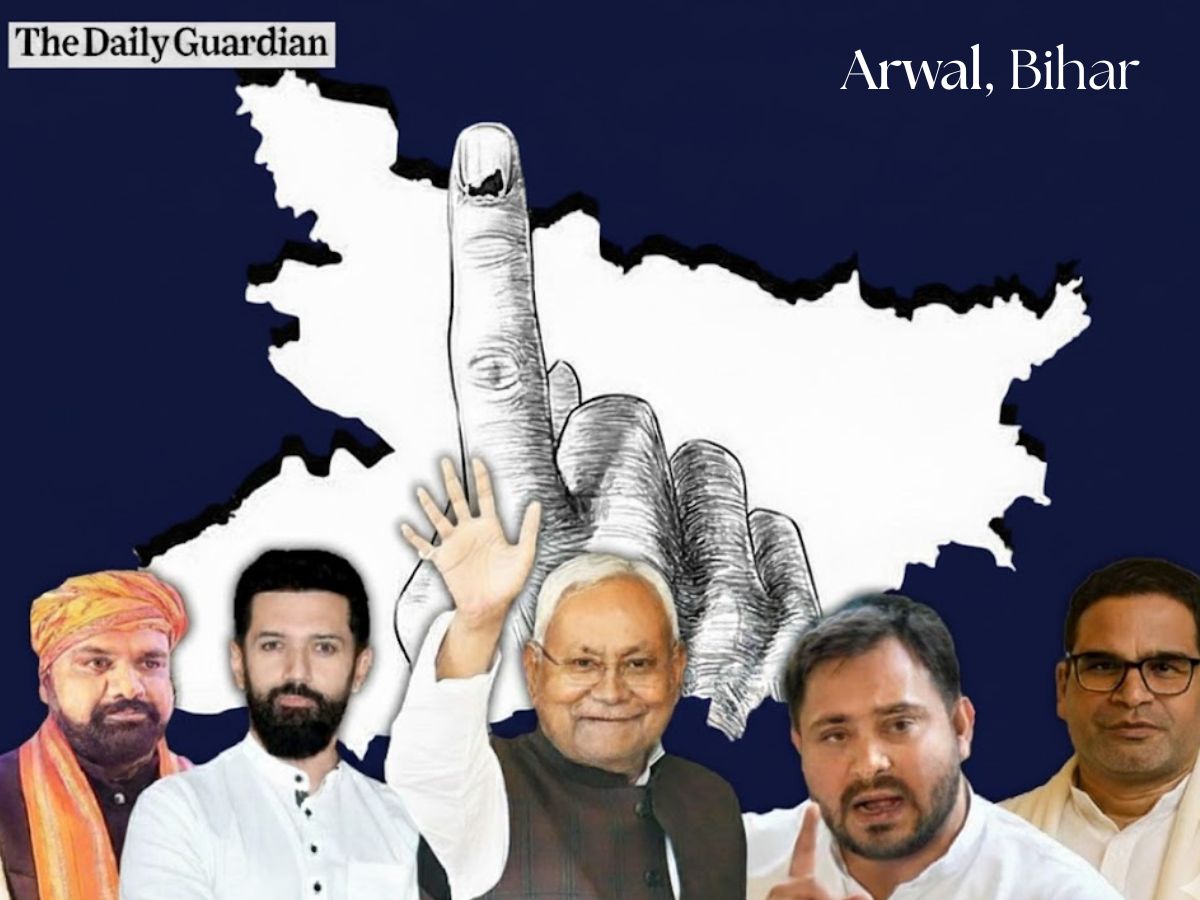
The 2025 Bihar Assembly elections have already geared up as voters are up to decide on key issues such as infrastructure growth, job creation, school standards, healthcare access, and safe public order. With 243 seats up for grabs, every constituency matters — and political parties have already announced their candidate lists in earnest. A party or alliance must secure at least 122 seats to stake a claim to power in the state.
Arwal town serves as the administrative headquarters of Arwal district. Earlier, it was part of Jehanabad district and was carved out as a separate district in August 2001. Among Bihar’s 38 districts, Arwal is the third least populous.
Arwal Election 2025 Date
The Arwal Assembly Election 2025 will be held on November 11, 2025.
Result Date of Bihar Polls
Counting of votes will take place on November 14, 2025, followed by the declaration of results on the same day.
Arwal Bihar Election Result 2020?
In the 2020 Assembly elections, the CPI(ML)(L), which contested as part of the RJD-led Mahagathbandhan, won the Arwal seat comfortably, defeating the BJP by 19,950 votes. The 2024 Lok Sabha polls further reinforced the challenge for the BJP and its allies in this constituency. The RJD not only won the Jahanabad parliamentary seat but also led by 15,730 votes over the JD(U) in Arwal.
Arwal Vidhan Sabha Chunav 2025: Candidates List
- Amitesh Kumar (IND)
- Arun Kumar (Janshakti Janta Dal)
- Chandra Shekhar Yadav (IND)
- Divya Bharti (Rashtriya Lok Janshakti Party)
- Kajal Devi (IND)
- Kunti Devi (Jan Suraaj Party)
- Mahanand Singh (CPI(ML)(L))
- Manoj Kumar (BJP)
- Manoj Kumar Santosh (IND)
- Mansur Alam (Aam Janta Pragati Party)
- Pancham Kumar (Suheldev Bharatiya Samaj Party)
- Satyendra Prasad Sharma (IND)
- Shekhar Ram (BSP)
- Veerendra Prasad (IND)
- Vikash Kumar (Desh Janhit Party)
Arwal Bihar Assembly Election Voting Time
The voting will start at 7:00 AM and will conclude at 5:00 PM.
What is the Population of Arwal?
Part of Bihar’s Magadh region, Arwal has a sex ratio of 927 females per 1000 males and a literacy rate of 69.54 per cent. The district comprises 335 villages, with only 7.40 per cent of the population living in urban areas. Scheduled Castes account for 20.16 per cent of the population. Hindus comprise 90.48 per cent of the population, while Muslims constitute 9.17 per cent. Magahi is the primary language for 86.53 per cent of residents, followed by Hindi (8.11 per cent) and Urdu (4.96 per cent).
How many Registered Voters are in Arwal?
In Arwal, Muslims make up about 9.4% of the electorate, while Scheduled Caste voters make up about 21.23%. Only 14.73 percent of voters are categorized as urban, with rural voters making up 85.27 percent of the electorate. Arwal had 258,687 registered voters and a 56.11 percent turnout in the 2020 Assembly elections. By the 2024 Lok Sabha elections, the number of voters had increased to 269,506.
Arwal was Established in?
Arwal was established as a separate district of Bihar on August 20, 2001. Before its establishment as an independent district, it was a sub-division within the Jehanabad District.
Prior established in 1951, Arwal is one of the six Assembly constituencies under the Jahanabad Lok Sabha seat. Given its volatile political history, the constituency has seen little stability. Voters have elected representatives from four different parties in the last four elections. Since its inception, Arwal has elected its MLA 17 times, with Independent candidate Krishna Nandan Prasad Singh winning three consecutive terms between 1980 and 1990.
The district was once part of the Red Corridor and witnessed several massacres. Violent conflicts over land disputes resulted from local Dalits retaliating against upper-caste communities after being provoked by Naxalite activity. Naxalites ruled the area in a number of instances, including the Senari massacre in 1999, which murdered 34 Bhumihars, and the Bara massacre in 1992, which killed 40 Bhumihars. The Bhumihars responded by forming the Ranvir Sena, a private militia, which carried out the Laxmanpur Bathe massacre in 1997, killing 58 Dalits.